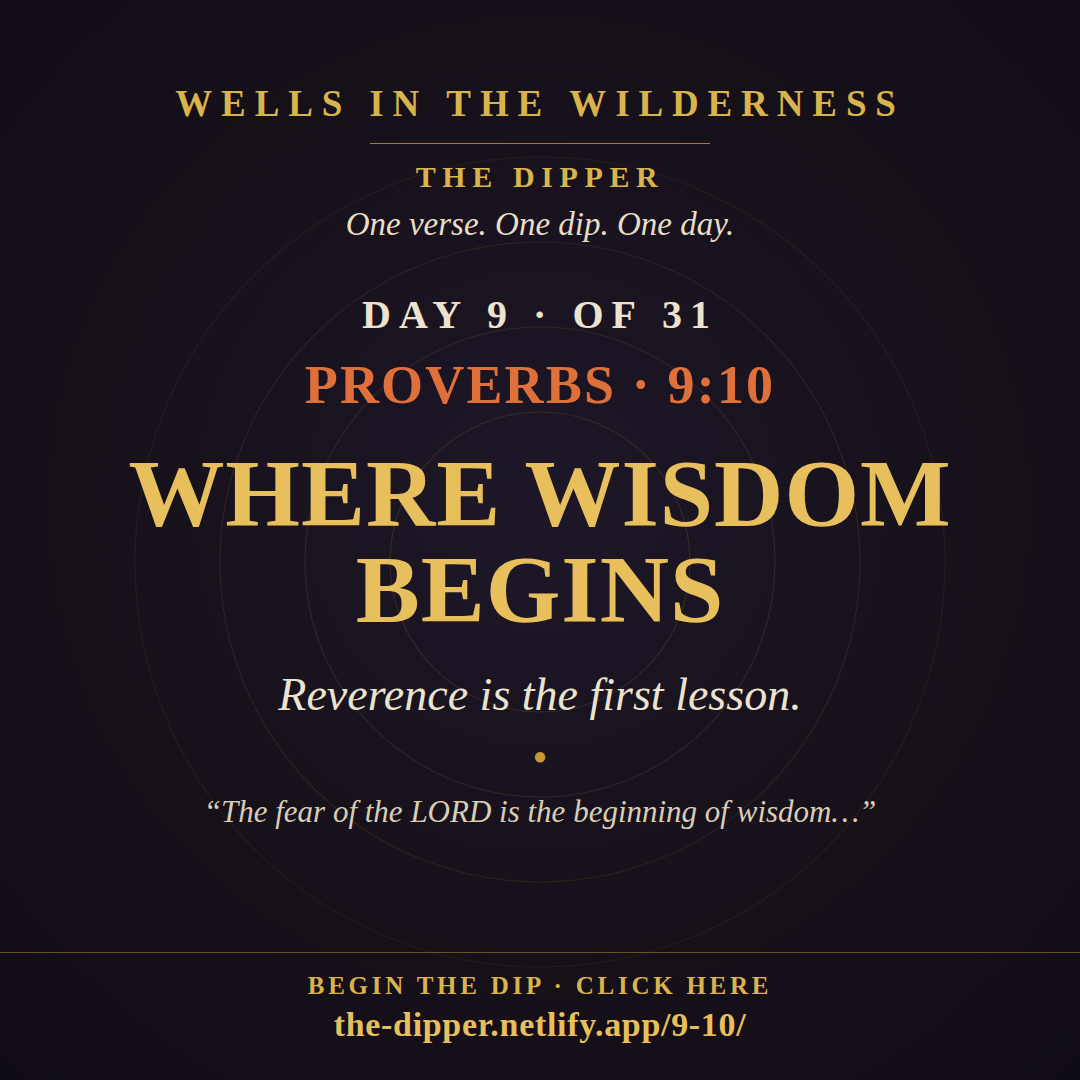
Where
Wisdom Begins
and the knowledge of the Holy One is insight.”
Nine chapters ago, the book opened with “the fear of the LORD is the beginning of knowledge” (1:7 — Day 1 at this well). Now the long prologue closes with its twin. Solomon has built a doorframe: two “beginnings,” one on each post, and everything from chapter 10 onward passes between them. If you keep one verse from this entire month, generations of believers would tell you — keep this one.
The Springs
What the verse says: wisdom — real skill at living — has a first step, and it is not a technique. It is standing in right awe of the LORD; and the deepest insight available to a human being is personal acquaintance with the Holy One.
Notice the two halves move inward: from awe (a posture) to knowledge of the Holy One (a relationship). The verse is a staircase. Fear of the LORD is where you plant your foot; knowing Him is where the stairs go.
The Wells
Different from 1:7's reshit (the foundation-stone word) — techillah is the starting point of a journey, the trailhead. Together the two words say something complete: the fear of the LORD is both the cornerstone wisdom is built on and the trail wisdom walks out from. You never build past it, and you never hike beyond it.
The same reverent awe from Day 1 — not terror that hides from God but wonder that draws near carefully. By placing it at both ends of the prologue, Solomon makes his structure preach: whatever else you learned in nine chapters of fathers, ants, wells, and warnings, it all hangs from this one nail.
Grammatically plural — “holy ones” — but referring to the one LORD: the Hebrew plural of majesty, holiness too vast for a singular noun. The astonishing move is the word in front of it: da'at, intimate knowledge. The verse holds both truths at full strength — utterly transcendent, personally knowable — and refuses to let go of either.
From bin, “to separate, to distinguish” — insight is the power to tell things apart: wise from clever, true from nearly-true, the road that is straight from the road that merely seems it. The verse's claim: that discernment is not a talent. It grows from acquaintance with the Holy One, the way a jeweler's eye grows from years of handling the genuine article.
wisdom's first step is awe of the Holy One.
The Aquifer
The doorframe
Structure is theology in Proverbs. Nine chapters of appeal are bracketed by two “beginnings” — knowledge at 1:7, wisdom at 9:10 — and the whole book will close on the same note (31:30). The repetition is the message: this is not one insight among many; it is the frame every insight hangs in. When Scripture builds a doorframe, it expects you to walk through it daily, not admire it once.
A beginning you never graduate from
Techillah — trailhead — kills a common misunderstanding: that the fear of the LORD is wisdom's kindergarten, left behind by the advanced. No traveler outgrows the trail he is walking. The saints who go deepest report more awe at the end than the beginning, not less. If reverence is shrinking as knowledge grows, the knowledge has left the trail.
Insight is the fruit of acquaintance
The second half explains where discernment actually comes from. Binah — telling things apart — grows from da'at Qedoshim, personal knowledge of the Holy One, the way bank tellers famously learn to spot counterfeit bills: by handling genuine currency until the false feels wrong in the hand. Time with God is not one input to discernment. It is the training set.
An anchor holds for a lifetime
Some verses are visited; this one can be lived in. A person can carry 9:10 from childhood into old age and find it load-bearing at every stage — the trailhead as a young person choosing a direction, the cornerstone in the building years, and the doorframe still standing when much else has been walked through and let go. Verses like this are given to be anchors. Drop this one deep.
Draw From the Well
Answer honestly. Write your answers down — ink slows the heart enough to hear.
Day 1 gave you reshit (cornerstone); today gives techillah (trailhead). Which picture does your soul need more right now — a foundation under you, or a direction out in front of you — and why?
The verse pairs total transcendence (the Holy One) with personal acquaintance (da'at). Which half do you over-weight — a God so holy He feels distant, or a God so familiar He shrinks? What would rebalancing look like?
Binah is counterfeit-detection — trained by handling the genuine. What decision are you currently facing where you need to tell the true from the nearly-true — and how much time have you spent with the genuine article this month?
Is your awe of God growing or shrinking as your knowledge grows? Answer honestly — and if it is shrinking, where did the knowledge leave the trail?
Some believers anchor their whole lives to a single verse, returning to it for decades. If 9:10 — or another verse — were to become that anchor for you, what would “dropping it deep” look like this year: memorized, prayed, taught, written where you will see it?
This Week’s Practice
- MORNINGStand at the trailhead: begin the day by reading 9:10 aloud, and let it set the direction before anything else does.
- MID-DAYHandle the genuine: spend ten unhurried minutes with the Holy One at mid-day — counterfeit-detection is trained, not wished for.
- EVENINGCheck the frame: tonight, name one decision from today and ask which doorway it walked through — awe of God, or something smaller.
Sources
- Hebrew text (Westminster Leningrad Codex): sefaria.org/Proverbs.9.10
- Lexicon — techillah (H8462): blueletterbible.org/lexicon/h8462
- Lexicon — yirah (H3374): blueletterbible.org/lexicon/h3374
- Lexicon — qadosh (H6918): blueletterbible.org/lexicon/h6918
- Lexicon — binah (H998): blueletterbible.org/lexicon/h998