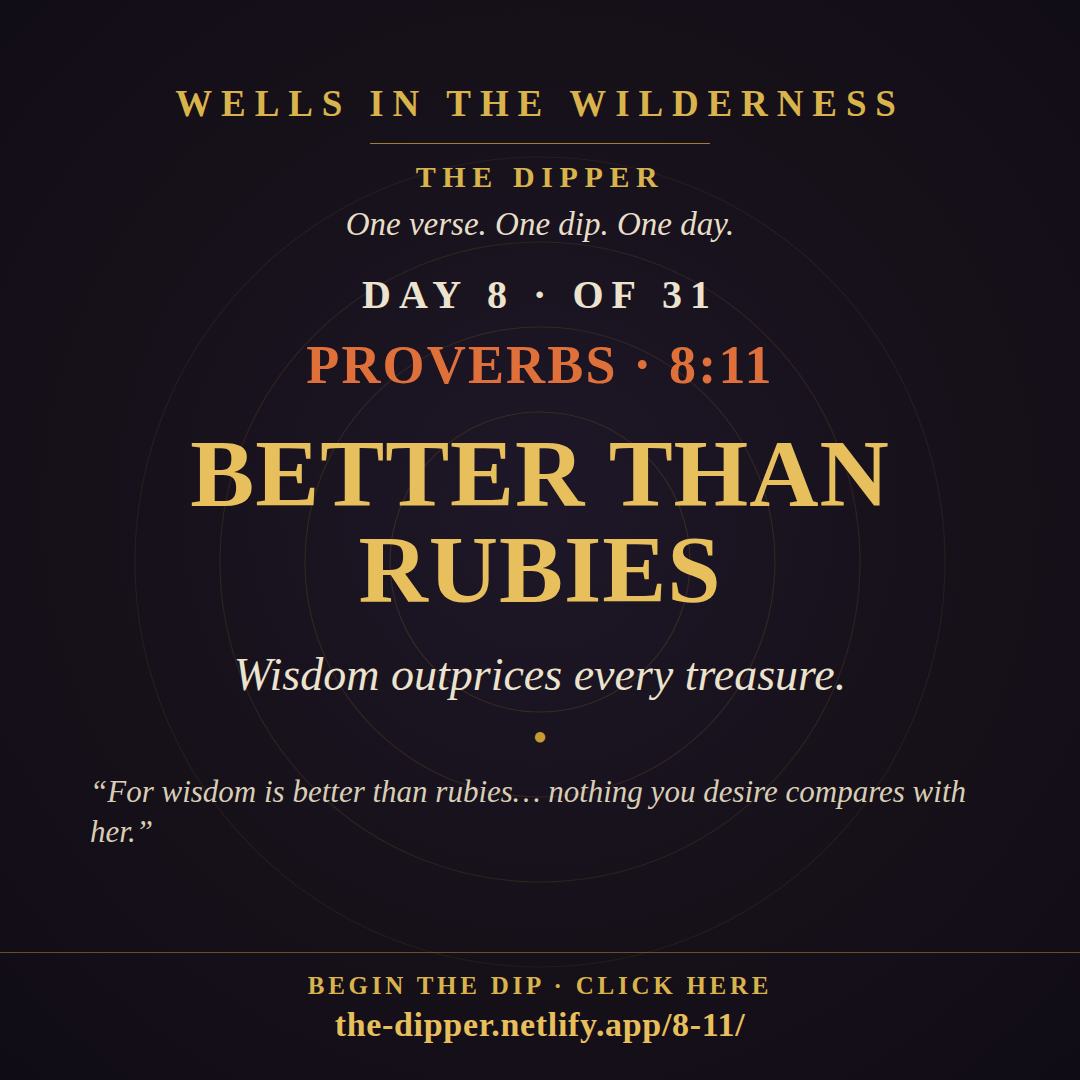
Better
Than Rubies
and all that you may desire cannot compare with her.”
Proverbs 8 is one of the most remarkable chapters in the Old Testament: Wisdom herself takes the podium. She stands at the crossroads and the city gates — the busiest real estate in the ancient world — and makes her pitch to everyone passing. This verse is her price tag, and she sets it deliberately against the whole market.
The Springs
What the verse says: put wisdom on one side of the scale and pile the other side with everything you could ever want — the scale doesn't move. She outweighs the lot.
Notice the verse's second half closes every loophole: not “wisdom is better than most things” but “all that you may desire cannot compare.” Solomon is not decorating; he is appraising. And he was the one man in history rich enough to run the experiment.
The Wells
The great evaluation word of Hebrew — the word God spoke over creation seven times in Genesis 1. When Proverbs says wisdom is tov beyond jewels, it borrows the Creator's own quality stamp: this is good the way light and land and life are good — foundationally, not decoratively.
Never abstract intelligence in this book — chokhmah is skill at living, the same word used for the master craftsmen of the tabernacle (Exodus 31:3). It is knowing how to build a life that holds weight: a marriage, a reputation, a soul. That is the commodity on the scale.
Likely red corals or pearls — in Solomon's world, among the rarest luxuries money could reach, imported at staggering cost. The word appears again at the book's end: the excellent wife of 31:10 is “far above peninim.” Proverbs keeps a consistent price list, and the rarest treasures are never minerals.
A weighing word: to be level, to balance, to be worth the same. The verse literally says no desirable thing can balance the scale against wisdom. It is an assayer's verdict, not a poet's flourish — the comparison was run, and the market lost.
you could want — and wins.
The Aquifer
The witness is qualified
This appraisal carries weight because of who ran it. Solomon had the gold, the fleets, the houses, the vineyards — Ecclesiastes 2 is his lab report: “whatever my eyes desired I did not keep from them.” He tested every item on the other side of the scale and wrote the result twice. When the richest man in the world tells you what outweighs riches, that is data, not sentiment.
Why wisdom outweighs the jewels
Rubies are inert — they sit in a vault and do nothing for your marriage, your temper, or your Tuesday. Chokhmah is active: it builds houses (24:3), guards hearts, steers words, saves lives. One is a store of value; the other is a generator of it. Everything the jewels could buy, wisdom can build — and wisdom keeps working after the jewels are spent.
Check your actual price list
Everyone carries an appraisal sheet, visible not in what we say but in what we chase. Hours, money, and attention flow toward what we've priced highest. The verse invites an audit: if a stranger reviewed your last month's calendar and spending, what would they conclude you value above rubies? The honest answer is where this Dipper does its work.
She is still at the gates
The scene around this verse matters: Wisdom is not hidden in a vault or a temple — she calls from the crossroads and the gates, the places everyone already walks (8:1–3). The priceless thing is, astonishingly, the available thing. James says it without the metaphor: “If any of you lacks wisdom, let him ask God, who gives generously” (James 1:5). The market's rarest good is free at the asking.
Draw From the Well
Answer honestly. Write your answers down — ink slows the heart enough to hear.
Audit honestly: based on where your hours, money, and attention actually went last month, what have you appraised as more valuable than wisdom?
Solomon ran the experiment — he had everything and wrote down what it weighed (Ecclesiastes 2). Whose life have you watched run the same experiment, and what did their result teach you?
Rubies store value; wisdom generates it. Name one concrete area — marriage, work, money, speech — where a piece of wisdom has already built something jewels could never buy.
Wisdom calls from the gates — the ordinary, public, available places. Where is wisdom currently available to you that you have been walking past — a counselor, a mentor, a book of Scripture, an honest friend?
James 1:5 says God gives wisdom generously to those who ask. What specific situation will you ask wisdom for tonight — by name, out loud?
This Week’s Practice
- MORNINGRun the audit: this morning, glance at yesterday's hours and spending, and write one honest sentence about what they say you treasure.
- MID-DAYBuy one gem: at mid-day, take in one proverb slowly — acquisition of the better commodity, on purpose.
- EVENINGAsk at the gate: tonight, ask God plainly for wisdom in one named situation — James 1:5 is a standing offer.
Sources
- Hebrew text (Westminster Leningrad Codex): sefaria.org/Proverbs.8.11
- Lexicon — tov (H2896): blueletterbible.org/lexicon/h2896
- Lexicon — chokhmah (H2451): blueletterbible.org/lexicon/h2451
- Lexicon — peninim (H6443): blueletterbible.org/lexicon/h6443
- Lexicon — shavah (H7737): blueletterbible.org/lexicon/h7737