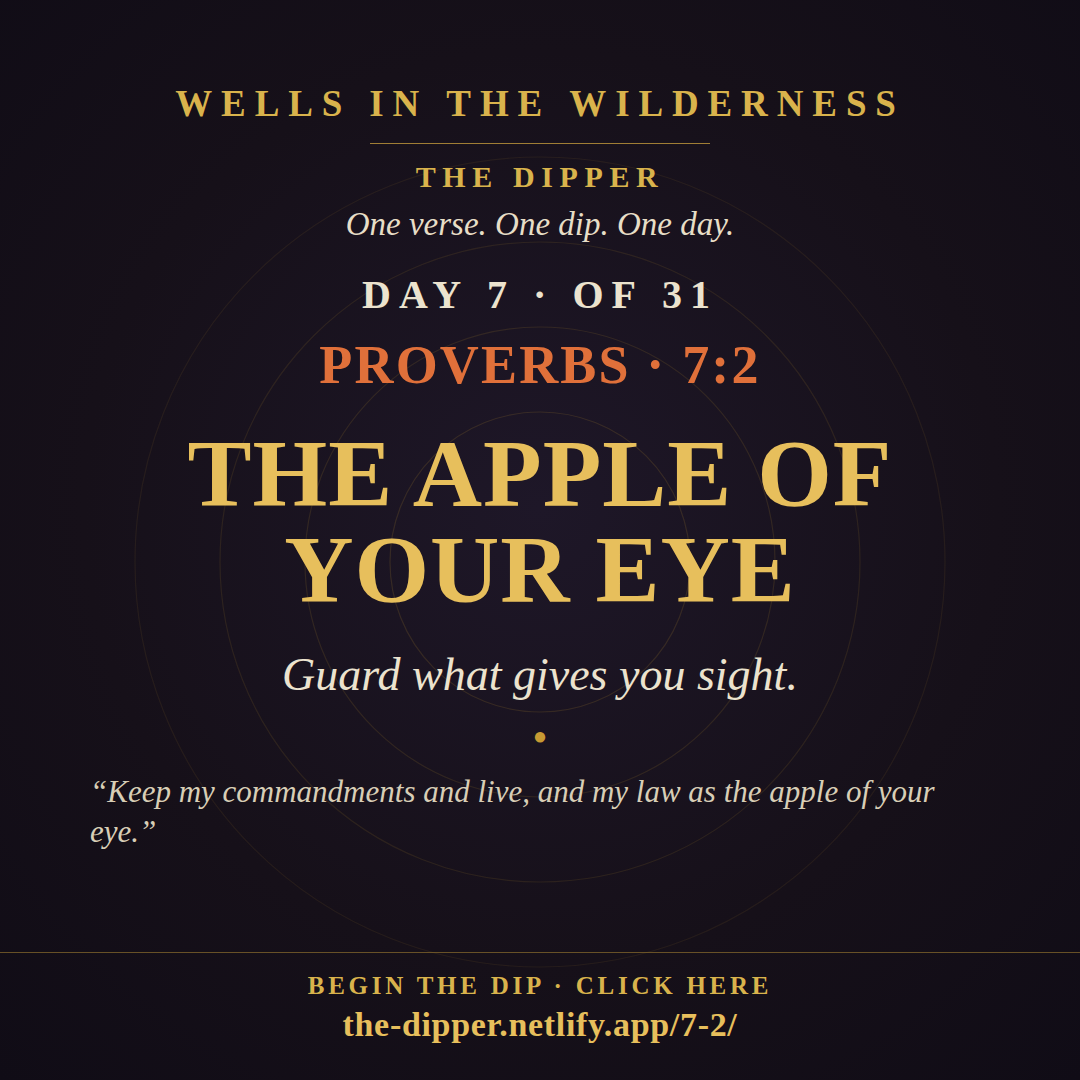
The Apple
of Your Eye
keep my teaching as the apple of your eye.”
You have said “the apple of my eye” your whole life — this verse is one of the places the phrase comes from, and the Hebrew behind it is stranger and better than the English. Hidden inside it is a tiny man, a reflex faster than thought, and a whole theology of how God's word protects the people who guard it.
The Springs
What the verse says: guard God's teaching the way your body guards your eye — instantly, by reflex, without stopping to debate — because the thing you protect turns out to be the thing protecting you.
Notice the trade hiding in the verse: keep the commandments and live. You guard the teaching; the teaching guards your life. Solomon places this at the door of chapter 7's danger story on purpose — what follows is a young man with no such reflex, and it does not end well.
The Wells
The verb of Eden — Adam was placed in the garden “to work it and keep it” (Genesis 2:15) — and of the priestly blessing: “the LORD bless you and keep you.” To shamar is to tend something precious as a sacred trust. The verse asks you to keep the word the way God keeps you.
Here is the buried treasure. Ishon is the diminutive of ish, “man” — the “little man of the eye,” because when you look closely into someone's pupil, you see a tiny person looking back: your own reflection. The Hebrew names the pupil after the moment of closest human nearness. That is how near the teaching is meant to live.
Before torah ever meant law codes, it meant this: a parent's instruction, from the verb yarah, “to point the way.” In Proverbs it is the father's accumulated direction for a son he loves. Guarding torah is not legal compliance; it is treasuring the pointed finger of Someone who can see the road you cannot.
A one-word promise: keep the commandments and live. Not “and be correct” — live. In Proverbs, life means the full thing: length of days, yes, but also sweetness, safety, a lit path. The verse's economy is stunning: the guarded word turns out to be armor worn over the eyes of the guard.
by reflex, without debate.
The Aquifer
The fastest reflex you own
Your blink reflex fires in about a tenth of a second — faster than deliberation, faster than choice. Something nears the eye and the lid is already closed. That is the standard the verse sets: protection of God's word so trained into you that it fires before the debate starts. Not “let me think about whether this compromise is wise” — the lid is already down.
Reflexes are trained, not wished for
No one deliberates their way into a reflex; they repeat their way into one. A boxer slips a punch he never consciously saw because of ten thousand slips in the gym. This is what daily Scripture actually builds — not information storage, but trained reaction. A Dipper a day is reflex training: small, repeated exposure until the word moves before you do.
Read the room the verse sits in
Proverbs 7 immediately tells the story of a young man “lacking sense” who wanders at twilight near the wrong corner — with no reflex, no guarded teaching, nothing that fires before the flattery lands. The chapter is the verse's proof by tragedy: he deliberates in the moment of temptation, and whoever deliberates there, loses there. The battle is won in training, weeks before.
You see yourself in what you guard
The ishon idiom carries one more gift: the little man in the pupil is your own reflection at closest range. Keep the teaching that near, and something quietly happens — you begin to see yourself truly in it, the way James describes the word as a mirror (James 1:23–25). What you guard at eye-level ends up showing you who you are, and who you are becoming.
Draw From the Well
Answer honestly. Write your answers down — ink slows the heart enough to hear.
Your blink reflex protects without deliberation. In what recurring situation do you currently deliberate — negotiate with temptation in the moment — where you need a trained reflex instead?
Reflexes come from repetition, not resolve. What is your current “gym schedule” with Scripture — honestly — and what would training for reflex, not just information, change about it?
The young man of Proverbs 7 fell at twilight, near the corner, at the time and place of weakness. What are your twilight and your corner — the predictable coordinates where your guard drops?
Torah here is a loving parent pointing the way, not a code demanding compliance. Which of God's instructions have you been treating as red tape that He meant as a pointed finger saving your life?
The promise is “keep my commandments and live.” Where have you already tasted that trade — a time when guarded obedience turned out to be guarding you?
This Week’s Practice
- MORNINGTrain one rep: take a single line of this verse into memory this morning and return to it five times before noon — repetition builds the reflex.
- MID-DAYMap the corner: name your “twilight” — the hour or setting where your guard predictably drops — and plan today's route around it.
- EVENINGCheck the mirror: at day's end, let the verse look back at you. Where did the reflex fire today? Where did deliberation sneak in?
Sources
- Hebrew text (Westminster Leningrad Codex): sefaria.org/Proverbs.7.2
- Lexicon — shamar (H8104): blueletterbible.org/lexicon/h8104
- Lexicon — ishon (H380): blueletterbible.org/lexicon/h380
- Lexicon — torah (H8451): blueletterbible.org/lexicon/h8451
- Lexicon — chayah (H2421): blueletterbible.org/lexicon/h2421