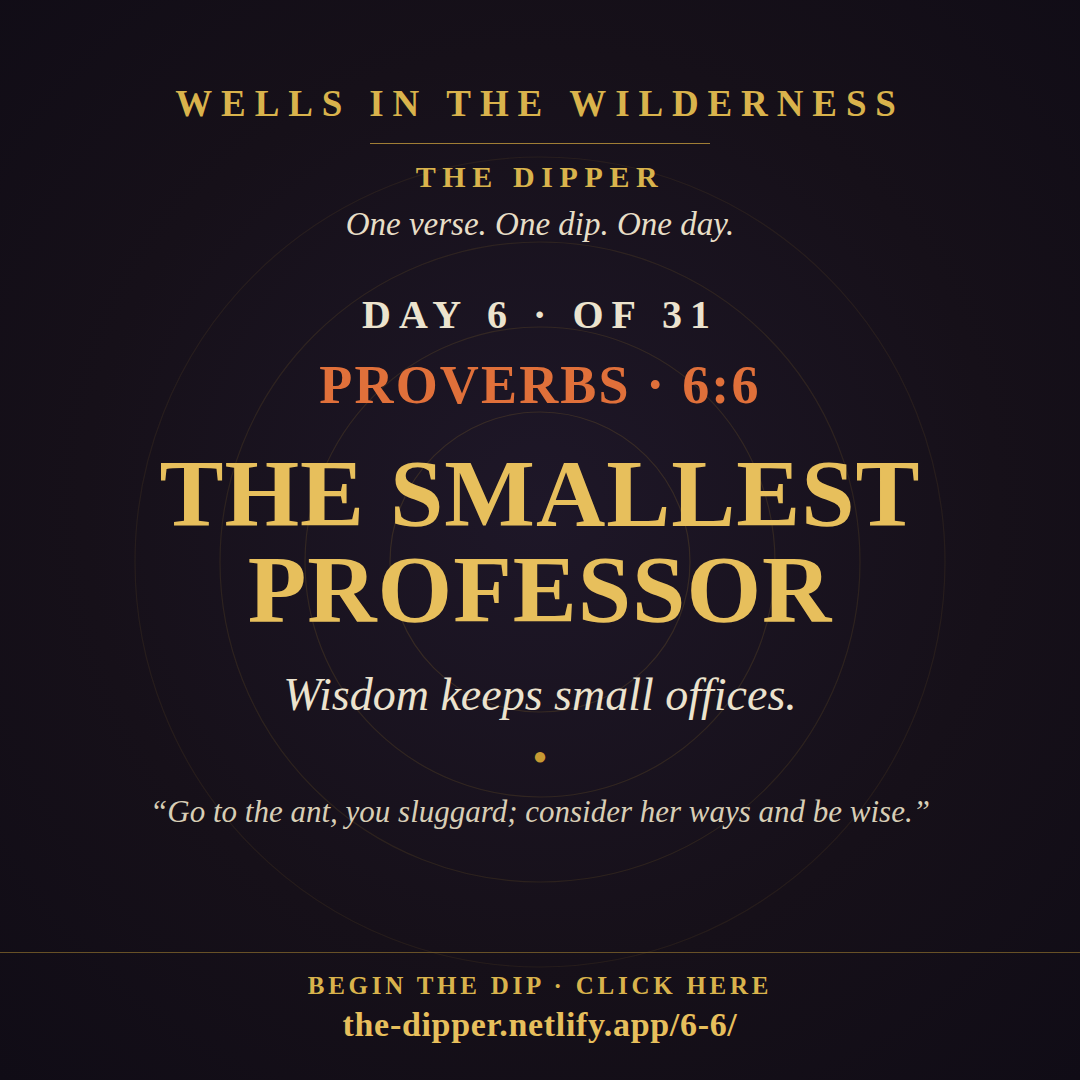
The Smallest
Professor
consider her ways, and be wise.”
Only in Proverbs does God enroll a grown man in a school taught by an insect. The verse is funny on purpose — and devastating on purpose. Solomon sends the laziest student in the book to the smallest professor in creation, and the lesson she teaches (verses 7–8) is one nobody sees coming.
The Springs
What the verse says: get up, walk outside, and watch an ant work — because she has mastered the thing you keep failing at, and she will teach anyone humble enough to look down.
Notice the three commands stack like steps: go, see, be wise. Wisdom in Proverbs is not downloaded; it is observed. God built lessons into creation and then built you with eyes. The only question is whether pride will let a man learn from something he could step on.
The Wells
The harvester ants of Israel do exactly what Solomon describes — haul grain all summer and store it in chambers for the wet season. The choice of professor is the point: no strength, no status, no size. If wisdom can be embodied by an ant, then no one gets to plead disadvantage. The curriculum is available at ground level.
Proverbs' recurring comic character — the man hinged to his bed like a door to its frame (26:14), who finds a lion in the street as an excuse to stay in (26:13). The atsel is not tired; he is stalled. His problem is never capacity. It is the gap between knowing and starting.
Not a glance — a study. The same verb Scripture uses when God saw that creation was good: attentive, evaluating sight. Solomon's method here is the scientist's method: go to the field, watch the specimen, draw the lesson. Wisdom literature insists the world is legible — creation is a textbook left open on purpose.
The imperative at the end of the chain — and in Proverbs, chokhmah is always skill-in-living, not abstract intelligence. The promise is remarkable: observation of a humble thing, honestly received, actually produces wisdom. The distance from sluggard to sage is three steps long: go, see, become.
in a school taught by an ant.
The Aquifer
The lesson nobody sees coming
Read verses 7–8 and the ant's secret lands: she works “having no chief, officer, or ruler.” No supervisor. No deadline. No one watching. The sluggard's real disease is exposed — he only moves when managed. The ant's wisdom is self-starting: she does the summer's work because winter is real, not because someone is standing over her. Maturity is what you do without a boss.
Work with the season, not against it
The ant “gathers her food in harvest” — she reads the calendar and works with time. Every life has summers (seasons when provision is possible) and winters (seasons when it is not). Wisdom asks: what season is it, and what does this season make possible that the next one will not? The sluggard's tragedy is always the same: he sleeps through harvest and is shocked by winter.
Small, repeated, relentless
No single grain the ant carries matters much. Ten thousand of them are a full storehouse. This is the mathematics of nearly everything that lasts — marriages, savings, skills, and a life in Scripture. One verse a day feels as small as one grain. Thirty-one chapters later, it is a barn. You are, at this moment, doing ant work. Keep hauling.
Humble enough to look down
The hardest command in the verse might be the first one: go to the ant — accept instruction from something beneath you. Pride wants impressive teachers. Wisdom takes the lesson from wherever God put it: an ant, a child, a hard day, a critic who happens to be right. The teachable get wise on schedule; the proud stay brilliant and stuck.
Draw From the Well
Answer honestly. Write your answers down — ink slows the heart enough to hear.
The ant works with “no chief, officer, or ruler.” Where in your life do you only move when someone is watching or requiring — and what would self-starting look like there?
What season is it — honestly — in your work, family, health, or faith? What does this season make possible that the next one will not, and are you gathering or sleeping?
Name the one stalled thing: the task, conversation, or habit you know to do and have not started. What is the actual first grain — the smallest physical next step — and when today will you carry it?
The sluggard's excuses are famous (“there is a lion in the street!”). What is your most-used lion — the respectable-sounding reason that keeps you in bed — and is it real?
Pride wants impressive teachers; wisdom learns from ants. Who or what has God placed “beneath” you lately that is trying to teach you something — and will you take the lesson?
This Week’s Practice
- MORNINGCarry one grain: pick the stalled task and do its smallest physical first step before noon — no supervisor required.
- MID-DAYRead the season: at mid-day, name what current season you are in and one thing it uniquely allows you to gather.
- EVENINGLog the haul: at day's end, write down the grains carried today — however small. Storehouses are built in entries.
Sources
- Hebrew text (Westminster Leningrad Codex): sefaria.org/Proverbs.6.6
- Lexicon — nemalah (H5244): blueletterbible.org/lexicon/h5244
- Lexicon — atsel (H6102): blueletterbible.org/lexicon/h6102
- Lexicon — ra'ah (H7200): blueletterbible.org/lexicon/h7200
- Lexicon — chakham (H2449): blueletterbible.org/lexicon/h2449