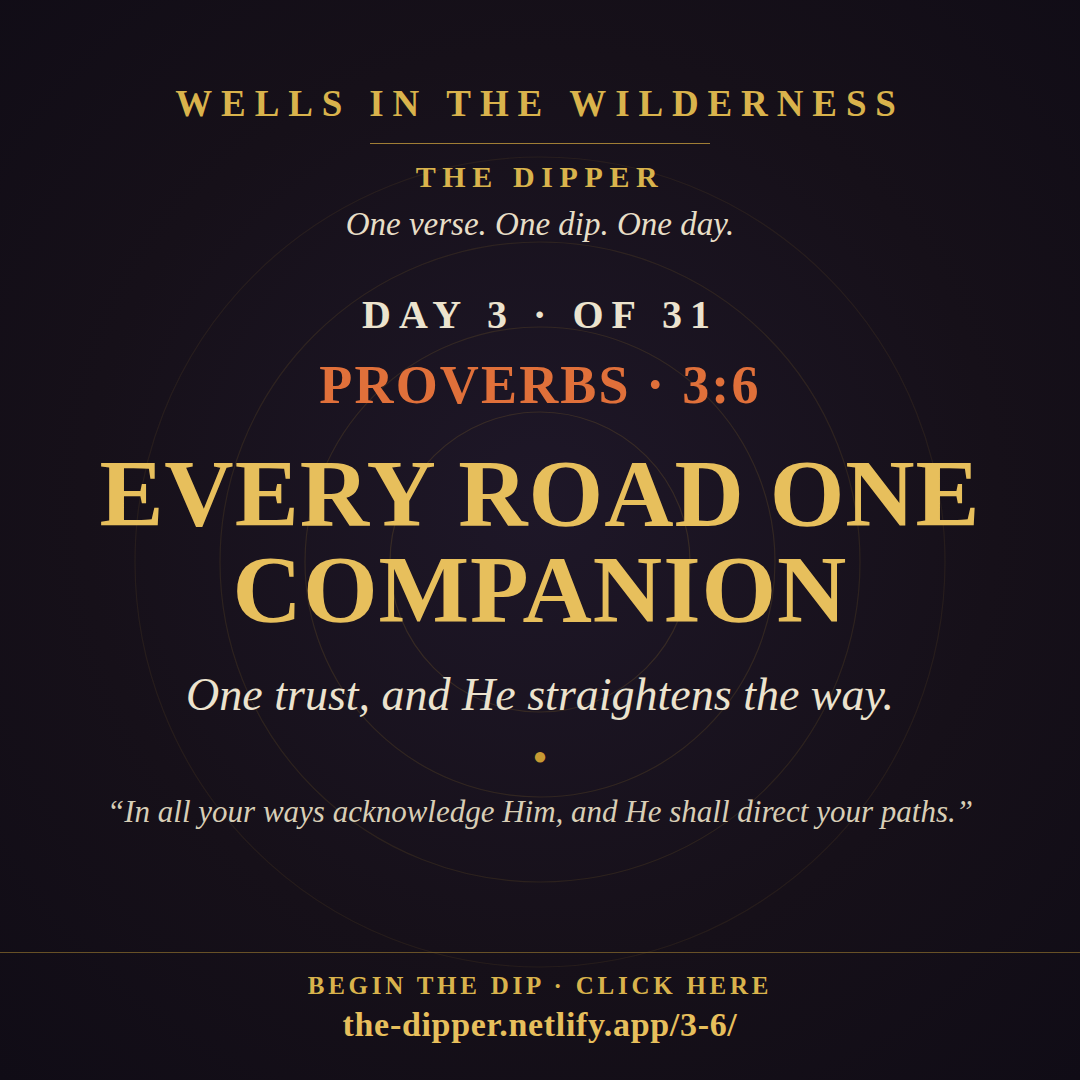
Every Road,
One Companion
and He will make straight your paths.”
This single verse sits at the center of one of the most beloved passages in all of Scripture (Proverbs 3:5–6). It was written for young people standing at the threshold of adult life — which means it was written for every one of us, because every day is a threshold. Four Hebrew words carry the weight of the verse. Learn them, and the verse will never read the same again.
The Springs
What the verse says: bring God into everything you do — not just the religious parts of your life — and He will take responsibility for getting you where you need to go.
Notice who does what. Your part is the knowing. His part is the straightening. The verse never asks you to straighten your own path. It asks you to walk every road in His company.
The Wells
Literally a trodden road — a path worn into the ground by repeated travel. In Israel’s wisdom literature, derek became the standard picture of a whole life: your habits, your decisions, your direction. “In all your ways” closes every loophole. There is no road — work, family, money, health, hobbies — that the verse leaves outside.
The heart of the verse — and the word English translations undersell. Yada is not “acknowledge” the way you acknowledge a text message. It is intimate, experiential, relational knowledge — the same verb Scripture uses for the union of husband and wife (Genesis 4:1) and for God’s covenant bond with His people (“You only have I known,” Amos 3:2).
In the treaty language of the ancient Near East, to “know” a king meant to recognize his lordship and live in loyal relationship with him. A listener in Solomon’s court would have heard the covenant ring immediately: not “tip your hat to God,” but “walk every road in loyal, personal fellowship with Him.”
The verb appears in the Piel stem — the intensive, active form. God does not merely permit straight paths; He actively straightens them. The picture is a road crew preparing a highway for a king: removing obstacles, filling ruts, leveling the grade — the same image behind Isaiah 40:3, “Make straight in the desert a highway for our God.”
A near-twin of derek, but often the well-worn caravan track. In Solomon’s day (10th century BC), travel was genuinely dangerous — winding, rocky, bandit-ridden roads where a wrong turn could cost your life. A straight, level path was not poetry to the original hearer. It meant one thing: you will actually arrive.
and He Himself will do the roadwork.
The Aquifer
No divided roads
Because derek covers every road, the verse refuses the sacred/secular split we quietly maintain. The question is not “Am I doing religious things?” but “Is there any road I am walking where I have left Him at the trailhead?” The workplace decision, the medical appointment, the difficult conversation, the budget, the browser — every one of them is a derek.
Relationship, not acknowledgment
Because yada is covenant intimacy, the application is not adding a quick prayer to your plans like a signature on a form. It is the difference between informing God of your decisions and walking with Someone who is already on the road. Anyone in a long marriage knows the difference between knowing about a person and knowing them. That is the verb. Practically, it looks like conversation with God in the middle of the task — not only at the bookends of the day.
He does the roadwork
Because yashar is intensive and active, the labor of straightening sits on God’s side of the ledger. The promise is not a smooth life; it is a passable road — obstacles dealt with, direction made clear, safe arrival guaranteed. Most of our anxiety comes from trying to work His side of the verse. Your assignment is the knowing. His assignment is the straightening.
The promise of arrival
The traveler in Solomon’s day heard “straight paths” and thought, I will actually get there. That is the takeaway for you: not a shortcut, not an easy road, but a promise of arrival — in the company of the One who knows the way.
Draw From the Well
Answer honestly. Write your answers down — ink slows the heart enough to hear.
List the five “roads” (derek) you travel most in a typical week. Which of them have you been walking without Him?
In your own words, what is the difference between “acknowledging” God and “knowing” (yada) Him? Where in Scripture do you see this kind of knowing modeled?
The verse assigns the straightening to God alone. Where in your life are you currently trying to do His job — and what is it costing you?
Read Genesis 4:1 and Amos 3:2, where yada describes the deepest human and divine relationships. What would it look like this week to know God on the road, mid-task, rather than only at the day’s bookends?
“Straight” meant safe arrival, not an easy trip. What destination are you trusting Him to bring you to — and can you name one obstacle you will now hand over to the Road-Builder?
This Week’s Practice
- MORNINGName one specific road you will walk that day — and invite Him onto it by name.
- MID-DAYStop and speak to Him in the middle of a task — practicing yada, not announcement.
- EVENINGRecord one way He straightened the road — an obstacle removed, a direction clarified, a safe arrival.
Sources
- Hebrew text (Westminster Leningrad Codex): sefaria.org/Proverbs.3.6
- Lexicon — yada (H3045): blueletterbible.org/lexicon/h3045
- Lexicon — yashar (H3474): blueletterbible.org/lexicon/h3474
- Lexicon — derek (H1870): blueletterbible.org/lexicon/h1870
- Lexicon — orach (H734): blueletterbible.org/lexicon/h734