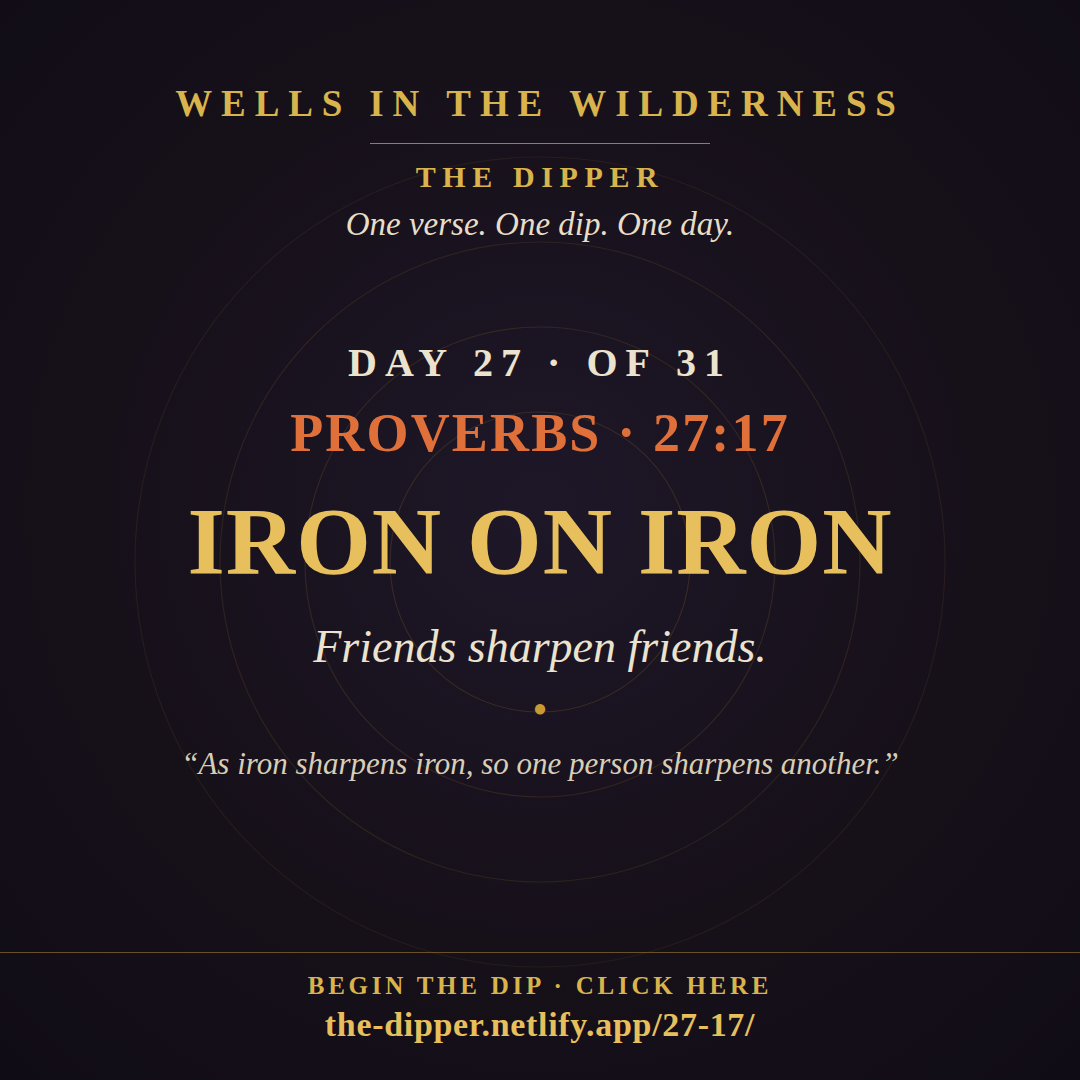
Iron
on Iron
and one man sharpens another.”
Everyone quotes this verse. Almost nobody notices what it actually requires — because sharpening is not a gentle process. Iron on iron means friction, pressure, heat, and sparks in a forge — and the Hebrew adds a detail every English translation smooths away: what gets sharpened is not the man in general. It is his face.
The Springs
What the verse says: people are honed the way blades are honed — by contact with something equally hard. Real friendship includes the grind: the pushback, the hard question, the honest edge — and both blades leave the encounter sharper.
Notice the mutuality built into the image. A file sharpens a blade one direction; iron on iron sharpens both. The verse describes a friendship of peers — two edges, each hard enough to matter to the other — which quietly rules out relationships where only one party is ever allowed to press.
The Wells
The hardest working metal of Solomon's world — plows, axes, swords. The choice of material is the first teaching: soft things do not sharpen anything. A friend capable of honing you must have substance of his own — convictions, backbone, an edge — which is precisely why a circle of soft agreement, however pleasant, leaves everyone in it dull.
To sharpen, to hone — and every ancient hearer knew the process behind the verb: pressure applied at an angle, friction sustained, metal actually removed, sparks. Sharpening is subtractive; something dull comes off. The verse never pretends the process is comfortable. It promises the process is worth it — an edge where there was a blunt.
The buried detail: literally, a man sharpens the face of his friend. In Hebrew, the face is the presence — the countenance, the self you bring into a room. Good iron-friends hone the face: they brighten the countenance, sharpen the perception, restore the bearing that trouble had dulled. Anyone who has left a true friend's table standing taller has felt the verb in this verse work.
The friend-word from Day 17 — the one who loves at all times, the brother born for adversity. Today completes his portrait: the all-times friend is not the all-agreement friend. The same covenant loyalty that shows up in your tight place also tells you the truth about your blind side — ‘faithful are the wounds of a friend’ says this very chapter, eleven verses earlier (27:6).
real sharpening includes the grind.
The Aquifer
Friction is the feature
We tend to want the verse's result without its process — sharp friends, no sparks. But the honing is the disagreement handled well: the friend who pushes back on your plan, questions your interpretation, names the pattern you cannot see. Verse 6 of this same chapter supplies the companion truth — ‘faithful are the wounds of a friend; profuse are the kisses of an enemy.’ A relationship where no one ever presses is not peaceful. It is a drawer where blades go dull together.
Audit the whetstones
Run the inventory honestly: who in your life is hard enough to sharpen you — and how have you been treating them? The pattern to watch for is quiet self-curation: over years, we drift toward the agreeable and away from the iron, then wonder at our own dullness. And the mutuality question cuts the other way too: are you iron for anyone — or have you become the soft friend, pleasant and honing no one, because pressing costs comfort?
How to take the grind
Being sharpenable is its own skill. When the faithful wound arrives — the correction that is accurate — the flesh has two escapes: flare (counterattack the friend) or flinch (withdraw from the friendship). The iron response is a third thing: stay on the stone. Hear it fully, thank them before defending, take the true part even if the delivery scraped. Day 1 defined the fool as the despiser of correction; the sharpenable man is his opposite, and he gets an edge for life.
Sharpening the face
Return to the Hebrew's gift: what iron-friends hone is the panim, the countenance. There is a whole ministry in that — the friend across the table who, by honest presence, restores the face trouble had slackened: perception sharpened, bearing recovered, the person sent back into their week with an edge. Ecclesiastes was written by the same king: ‘two are better than one… woe to him who is alone when he falls’ (4:9–10). Solitary blades dull quietly. Find the forge; be the forge.
Draw From the Well
Answer honestly. Write your answers down — ink slows the heart enough to hear.
Name your iron: who in your life is hard enough — in conviction and honesty — to actually sharpen you? When did you last let them press?
Audit the drift: over the past five years, have you curated your circle toward agreement and away from friction? What has that cost your edge?
When the faithful wound arrives, is your reflex flare, flinch — or staying on the stone? Recall the last accurate correction you received: which did you do?
Turn the mutuality around: for whom are you iron? Is there a friend who needs your honest pressure this month — and has been getting only your pleasantness?
The Hebrew says friends sharpen the face. Whose countenance could you hone this week — restore their bearing, brighten their presence — simply by honest time across a table?
This Week’s Practice
- MORNINGSit on the stone: invite one hard question from a trusted friend today — ask them directly what they see that you don't.
- MID-DAYBe iron once: offer one honest, loving pushback you have been withholding for comfort's sake.
- EVENINGHone a face: give one friend unhurried presence across a table this week — and send them back sharper than they came.
Sources
- Hebrew text (Westminster Leningrad Codex): sefaria.org/Proverbs.27.17
- Lexicon — barzel (H1270): blueletterbible.org/lexicon/h1270
- Lexicon — chadad (H2300): blueletterbible.org/lexicon/h2300
- Lexicon — panim (H6440): blueletterbible.org/lexicon/h6440
- Lexicon — rea (H7453): blueletterbible.org/lexicon/h7453