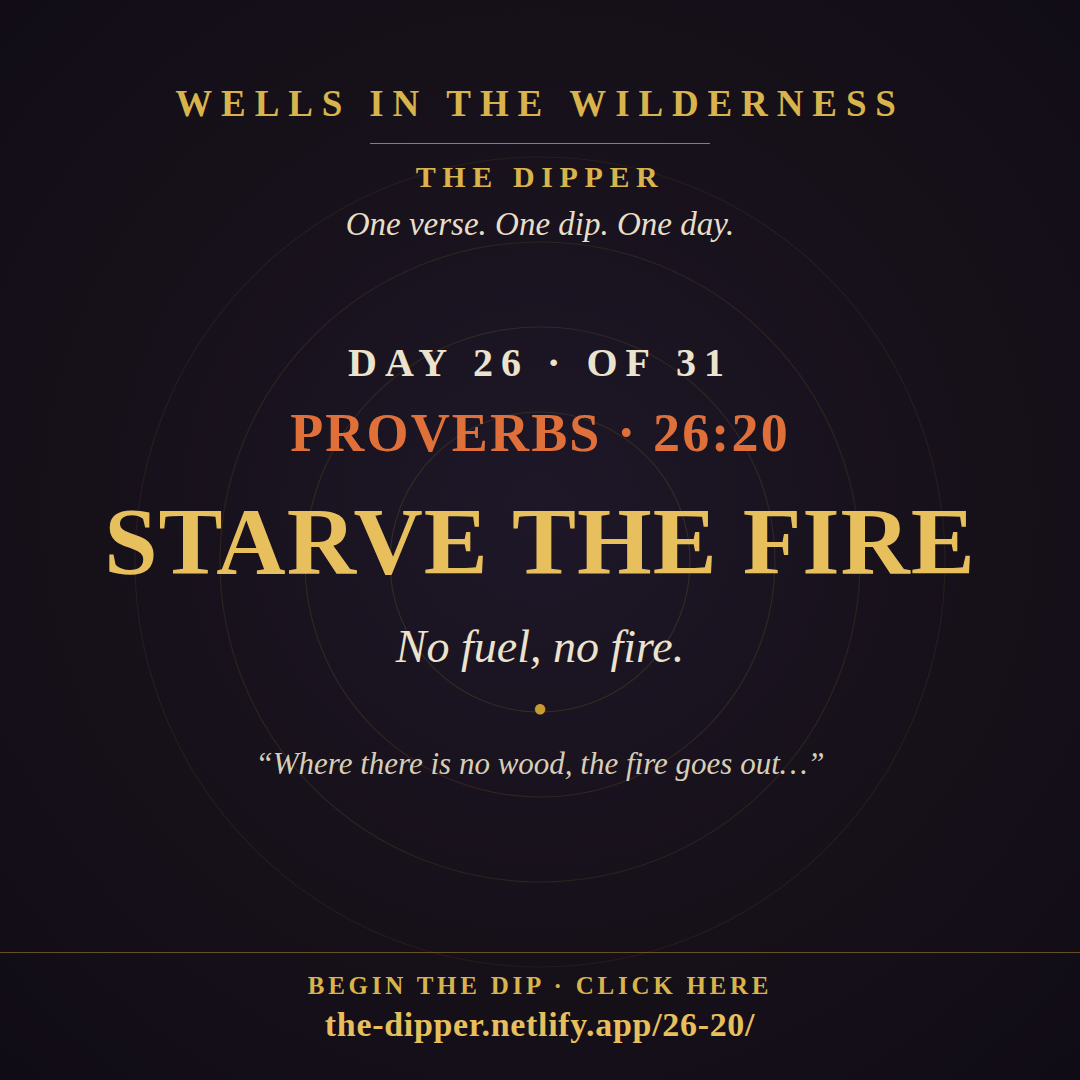
Starve
the Fire
and where there is no whisperer, quarreling ceases.”
Solomon hands you a piece of combustion science and lets it preach. Every fire in the ancient world — and every quarrel in any world — obeys the same law: no fuel, no flame. The verse then identifies exactly what a conflict burns for fuel, and it is not the original offense. It is the whisper.
The Springs
What the verse says: quarrels do not sustain themselves. Like fires, they burn only as long as someone keeps carrying wood — and the wood of a quarrel is gossip: the retold grievance, the passed-along remark, the whisper that keeps the coals fed.
Notice the hope hiding in the physics. If conflicts needed no fuel, they would burn forever. But the verse says every feud in your family, church, or workplace is one interrupted supply line away from going quiet — yishtok, it falls silent — the moment the wood stops arriving.
The Wells
Firewood — gathered, carried, and fed in stick by stick. The image insists on agency: wood does not walk to fires. Every log on a quarrel's flames got there because a person picked it up and carried it — the repeated story, the screenshot forwarded, the ‘did you hear what she said about you.’ Fires look self-sustaining. They never are.
Fire is Scripture's standing image for the destructive power of speech — James took it to its full length: ‘the tongue is a fire… how great a forest is set ablaze by such a small flame!’ (James 3:5–6). The metaphor is precise about damage, too: fires do not injure selectively. Quarrels, once burning, consume the innocent along with the involved — children, congregations, decades of friendship.
The murmurer, the gossip — from a root suggesting a low, rolling grumble. Two verses later, Proverbs describes his product with unsettling accuracy: ‘the words of a whisperer are like delicious morsels; they go down into the inner parts’ (26:22). That is the whole problem — gossip is not repulsive; it is tasty, engineered to be swallowed and stored deep. The whisperer's power is entirely dependent on willing ears.
Sustained contention — not a flash of anger but the long-burning feud, the conflict with a supply chain. And note its verb in this verse: without the whisperer, madon ‘falls silent.’ Not ‘is resolved by tribunal’ or ‘won by the right side’ — it simply loses its voice and goes out, the way a fire dies: undramatically, from hunger.
and you can be the missing wood.
The Aquifer
Find the supply line
The verse turns you from firefighter into investigator. When a conflict in your family, church, or workplace keeps reigniting past all reason, stop asking who started it — Day 15 already retired that question — and ask what is feeding it: which conversations, which retellings, which parties who are somehow always nearby when the flames jump. Most long feuds have a short supply line. The verse's whole strategy is logistics: fires are not argued out. They are starved out.
Refuse to carry wood
The most direct application is one decision: the retold grievance dies with you. When the delicious morsel arrives — and 26:22 admits it will be delicious — you simply do not forward it: not with ‘you didn't hear this from me,’ not as a prayer request, not as concerned analysis of a third party's faults. This is unglamorous obedience with outsized effects; one person who reliably absorbs whispers instead of relaying them can, over time, put out fires across an entire community.
Starve the ears, too
The whisperer needs listeners the way fire needs oxygen, which makes receiving gossip a form of feeding it. There are gracious shut-offs: ‘Have you said this to her directly?’ — ‘I'd rather hear his side before we go on’ — or simply declining the morsel with a subject change. It costs a moment of social awkwardness and buys the silence of madon. A community's fires are ultimately controlled by what its ears will and will not eat.
The whisperer inside
One more fire, closer to home: the quarrel you conduct alone. Grievance rehearsal — replaying the offense, drafting the retorts, narrating the case against them on your pillow at night — is whispering to yourself, log after log onto a fire no one else even attends. The same physics applies: stop carrying the wood. Take the grievance once to God in full (the Psalms show how), take it to the person if it needs taking (Matthew 18:15), and then refuse it further fuel. Interior fires also die of hunger.
Draw From the Well
Answer honestly. Write your answers down — ink slows the heart enough to hear.
Investigate one long-burning quarrel you know well: what is its actual supply line — which retellings, conversations, or parties keep the wood arriving?
26:22 admits gossip is delicious. When the next morsel arrives, what will your gracious shut-off be — the exact sentence you'll use to decline it?
Where have you been carrying wood while calling it something else — a prayer request, concerned analysis, 'just venting'? What retold grievance needs to die with you this week?
Name your interior fire: the offense you rehearse alone, logs on at night. What would starving it look like — taken once to God fully, then refused further fuel?
One reliable whisper-absorber can quiet a whole community's fires over time. In your family or church, is that person currently you — and if not, what would it take to become them?
This Week’s Practice
- MORNINGCut one supply line: identify one way you feed a current conflict — a retelling, a listening ear — and close it today.
- MID-DAYDecline one morsel: when gossip arrives, use your prepared shut-off sentence — gracious, brief, final.
- EVENINGStarve the pillow fire: tonight, take the rehearsed grievance to God once, in full, out loud — and carry it no more wood.
Sources
- Hebrew text (Westminster Leningrad Codex): sefaria.org/Proverbs.26.20
- Lexicon — ets (H6086): blueletterbible.org/lexicon/h6086
- Lexicon — esh (H784): blueletterbible.org/lexicon/h784
- Lexicon — nirgan (H5372): blueletterbible.org/lexicon/h5372
- Lexicon — madon (H4066): blueletterbible.org/lexicon/h4066