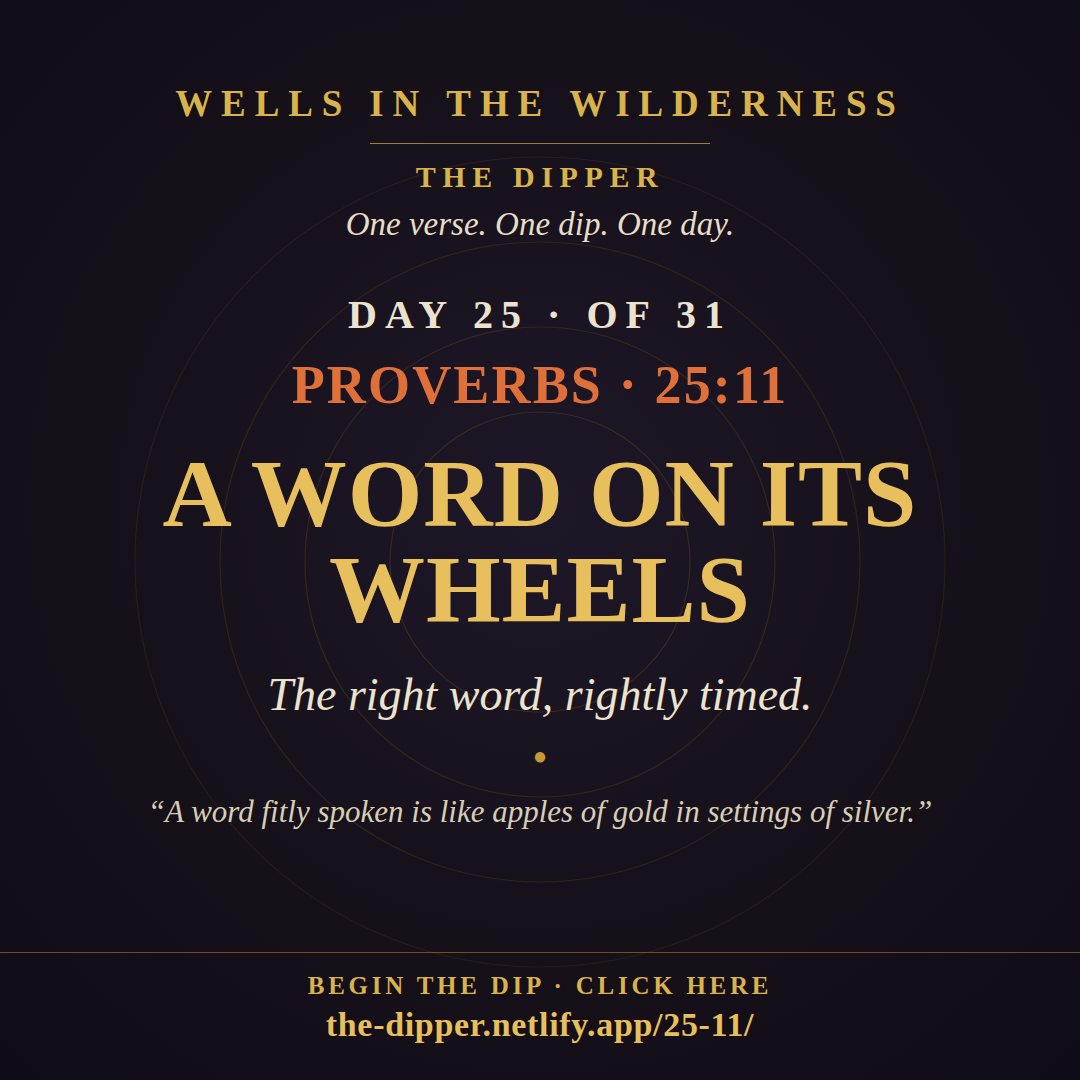
A Word
on Its Wheels
in a setting of silver.”
Welcome to the Hezekiah Collection — proverbs of Solomon copied out by King Hezekiah's men two centuries later (25:1), courtiers whose profession was weighing words before kings. Fitting, then, that one of its first gems is about the craftsmanship of speech itself. The Hebrew behind ‘fitly spoken’ is one of the loveliest idioms in the book: a word on its wheels.
The Springs
What the verse says: the right word, delivered at the right moment in the right way, is jewelry — gold set in silver, precious twice over: once for what it is, once for how it is presented.
Notice the verse prices the fitness, not just the content. Plenty of true words are spoken badly — right sentence, wrong moment, wrong tone, wrong ear — and land as lead. What turns truth into gold-in-silver is the craftsmanship of its arrival.
The Wells
Golden fruit — possibly ornamental apples or apricots wrought in gold, the kind of luxury craft-piece a royal court would display. The image chooses beauty that was made: fruit that took a goldsmith weeks. The verse's first claim about excellent speech is that it is fashioned, not blurted — somebody worked that word before it was worn.
Likely carved silver filigree — the openwork frame a jeweler builds around a centerpiece. Here is the verse's subtlest teaching: the setting is what you don't say. Timing, restraint, the listening that precedes, the silence around the sentence — that is the silver. An unframed gem rolls off the table; most wasted true words failed for lack of filigree, not lack of gold.
Hebrew doubles the root — ‘a word worded,’ speech that has been through its own process. The doubling is the craftsmanship made audible: this word was considered, weighed, shaped, and only then released. The same root carried Day 12's davar tov, the good word that lifts a bent heart — today's verse explains how such words get made.
The idiom of the verse: literally ‘upon its wheels.’ A word on its wheels is a word that arrives — rolling in at exactly the moment and by exactly the route the moment required. Anyone who has received one knows the sensation: the sentence that pulled up beside you precisely when you could hear it. Wheels are the difference between a delivery and a dumping.
and somebody crafted it before you wore it.
The Aquifer
Fitness is a fourfold craft
Pull the idiom apart and a word's ‘wheels’ have four spokes: the right content (is it true and needed?), the right time (can they hear it now — or is grief, anger, or an audience blocking the ears?), the right manner (Day 15's soft answer governs the temperature), and the right ear (is this mine to say to this person at all?). Most speech failures are not content failures. They are wheel failures — true things delivered on broken axles.
The silver is the silence
The filigree deserves its own meditation. What frames a golden word is largely restraint: the ten sentences you did not say around the one you did; the listening that earned the right to speak; the pause that let the word land instead of burying it under the next one. The Hezekiah collection says it outright a chapter later — even a fool who keeps silent is counted wise (17:28 states the principle; the collection returns to it repeatedly). If your gold keeps rolling off tables, add silver.
Words worth wearing for decades
Here is the proof of the verse in your own life: you can still quote them — the sentence a parent, teacher, or friend spoke at the exact hinge-moment, decades ago, and you have worn it like jewelry ever since. One fitly spoken word can outlast the speaker. Which reframes today's ordinary conversations: somewhere in them may be the sentence someone quotes at your funeral. Craft accordingly.
Apprenticed to the Master Jeweler
Scripture's supreme examples of words on wheels come from One who ‘knew how to sustain with a word him who is weary’ (Isaiah 50:4) — and the same verse tells where the skill came from: ‘Morning by morning he awakens my ear to hear as those who are taught.’ The craft is learnable, and the workshop is the morning ear. People who receive words daily — at wells like this one — slowly become people who can give them fitly. You are in the apprenticeship right now.
Draw From the Well
Answer honestly. Write your answers down — ink slows the heart enough to hear.
Name the fitly spoken word you still wear — the sentence someone delivered at a hinge-moment years ago. What made its wheels perfect: the content, the timing, the manner, or the person?
Which of the four spokes do you most often break — wrong content, wrong time, wrong temperature, or speaking what wasn't yours to say? What did your last broken-axle delivery cost?
Audit your silver: around your true words, how much filigree is there — listening first, restraint, the pause after? Where does your gold keep rolling off the table for lack of frame?
Who in your life is at a hinge-moment right now — and what is the crafted word (not the blurted one) that could arrive on wheels this week?
Isaiah 50:4 ties the skill of sustaining words to the morning ear. What would apprenticing to the Master Jeweler look like in your actual mornings?
This Week’s Practice
- MORNINGCraft one word: choose one person and one sentence, shape it in the morning — content, time, manner — and deliver it on wheels today.
- MID-DAYAdd silver: in one conversation, deliberately listen twice as long before speaking once — build the filigree first.
- EVENINGLog the jewelry: tonight, write down one word you have worn for years and thank God — or the speaker, if you still can — for the craftsmanship.
Sources
- Hebrew text (Westminster Leningrad Codex): sefaria.org/Proverbs.25.11
- Lexicon — tappuach (H8598): blueletterbible.org/lexicon/h8598
- Lexicon — maskith (H4906): blueletterbible.org/lexicon/h4906
- Lexicon — davar (H1697): blueletterbible.org/lexicon/h1697
- Lexicon — ophen (H655): blueletterbible.org/lexicon/h655