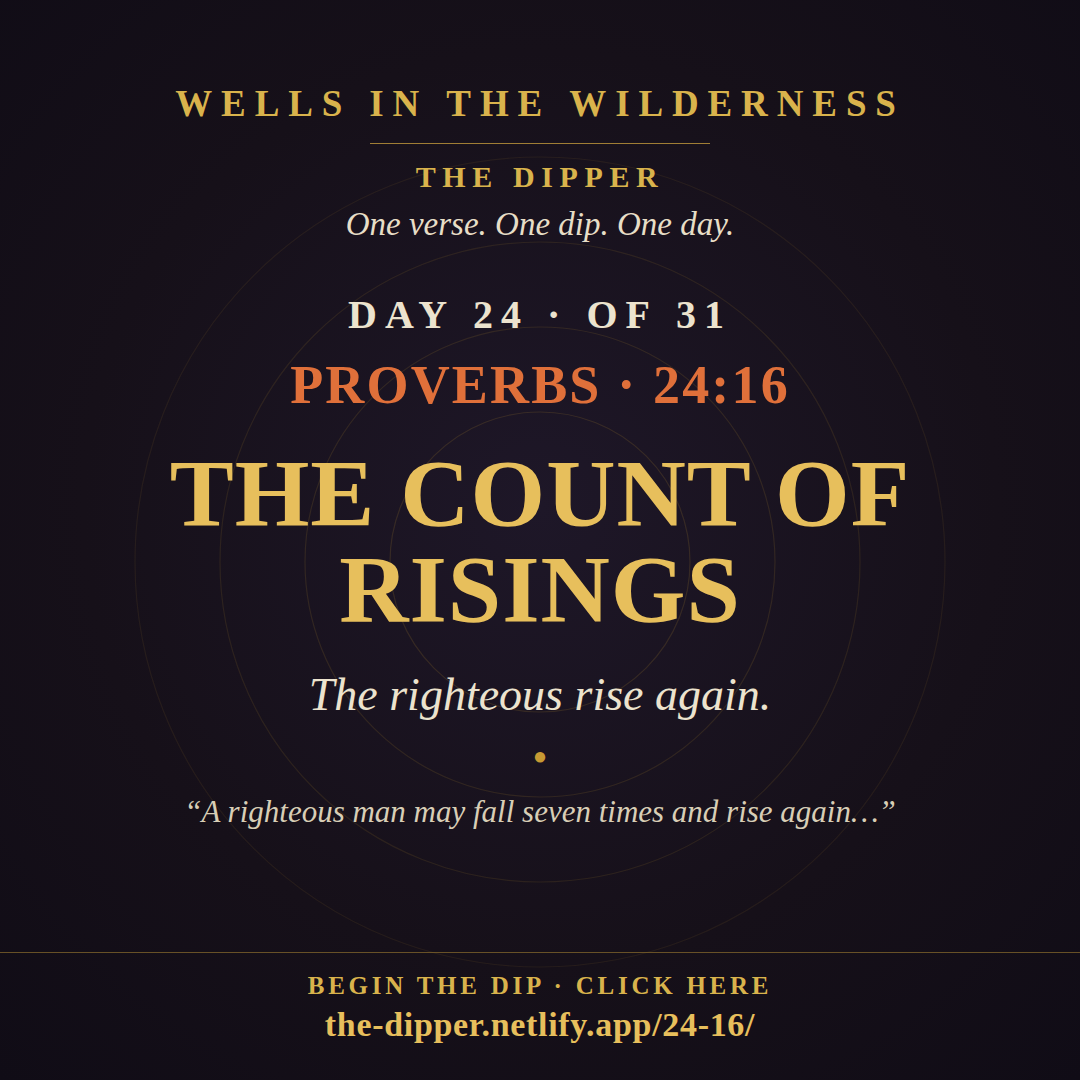
The Count
of Risings
but the wicked stumble in times of calamity.”
Read this verse slowly, because it quietly redefines a word most of us have wrong. We assume ‘the righteous’ means the person who does not fall. Solomon assumes the opposite — his righteous man falls seven times, completeness itself — and locates the righteousness somewhere else entirely: in a single Hebrew verb, two letters long, that keeps happening.
The Springs
What the verse says: righteousness is not measured by the absence of falls. The righteous man's biography is full of them — seven, the number of fullness. What distinguishes him is the count of risings: every fall is followed by a getting-up.
Notice the contrast the verse actually draws. The wicked are not the ones who fall more — they may fall once — but when calamity comes, they stay down, because nothing was under them. The difference between the two men is not the pavement. It is what each one is standing on when he stands back up.
The Wells
The number of completeness in Hebrew — seven days, sevenfold, seventy times seven. ‘Falls seven times’ does not mean exactly seven; it means the falls run the full course — as many as a whole life can hold. The verse budgets for a complete set of failures in the righteous man's story and does not blink.
Real falling — the ordinary Hebrew word for going down: in battle, in failure, on your face. Scripture never euphemizes the falls of its righteous; it publishes them. Abraham's lies, Moses' temper, David's catastrophe, Peter's three denials — the Bible is a book of documented naphal, written that way on purpose, so no one who has fallen would think themselves disqualified from its pages.
Two letters in Hebrew — qum — and the whole verse turns on them. To arise, to stand, to get up: the verb of mornings, of resurrection (‘Talitha koum,’ Jesus said to the girl — the same Semitic root). Note the grammar: he falls seven times and rises — singular, simple, as certain as the falls. The rising is presented not as heroics but as what this kind of man simply does next.
The wicked's verb is different: to stumble, totter, collapse — and stay collapsed. Their fall comes ‘in calamity,’ a single storm, and it finishes them, because their standing was circumstance all along. The verse's physics: what you are standing on determines whether a fall is a chapter or the ending.
it is the count of risings.
The Aquifer
Redefining the righteous man
This verse dismantles the perfectionism that quietly poisons many believers — the assumption that real Christians do not fall, so my fall proves I was never real. Solomon's righteous man has a complete set of falls in his file. His righteousness is not a spotless record; it is a covenant relationship that keeps producing qum. If your story contains falls — recent ones, repeated ones, embarrassing ones — this verse does not read you out of the category. The falls were never the disqualifier.
The power source of the rising
Where does qum come from, seven times over, when the man's own strength failed seven times? Micah answers from inside the experience: ‘Rejoice not over me, O my enemy; when I fall, I shall rise, when I sit in darkness, the LORD will be a light to me’ (Micah 7:8). The rising is not self-generated grit. It is grace with a grip — the same hand from Day 21, now under an arm. The righteous get up because Someone keeps getting them up.
What the wicked never built
The second line explains the first. The wicked stumble once in calamity and stay down because their stability was always circumstantial — the market, the health, the reputation, the luck. When the storm removes the circumstance, there is nothing beneath. Jesus told this exact verse as a parable: two houses, same storm, and the difference was entirely foundation (Matthew 7:24–27). The falls in your life are also soundings — they tell you what you are actually built on.
After the seventh fall
Somewhere at this well is a reader on the ground right now — fall number four, or six, or a number past counting, and ashamed to get up in front of a God who watched. Hear the verse's arithmetic: the getting-up is not presumption; it is the family trait. Peter's restoration after his triple fall ended not with probation but a commission — ‘feed my sheep’ (John 21). In this Book, the risings outnumber the falls by exactly one, every time. Get up. That is what the righteous do.
Draw From the Well
Answer honestly. Write your answers down — ink slows the heart enough to hear.
Where has perfectionism taught you that falling disqualifies you — and what does it change to find a complete set of falls budgeted into the righteous man's biography?
Recall your hardest getting-up. Looking back honestly, how much of that qum was your own grit — and how much was grace with a grip on your arm?
Falls are soundings: they reveal the foundation. What did your last fall expose about what you were actually standing on — and what needs to be under you before the next one?
Is there a fall you have stayed down from — a failure you decided was the ending rather than a chapter? What would rising look like in concrete terms this month?
Peter fell three times in one night and was restored to feed the sheep. Who in your life is on the ground and ashamed — and how could you be part of their qum this week?
This Week’s Practice
- MORNINGRecount the risings: this morning, name three past falls God raised you from — the count of risings is your actual record.
- MID-DAYRise once today: take one concrete step up from the fall you have stayed down from longest — a call, a confession, a return.
- EVENINGSteady someone's arm: reach one person who is down and ashamed, and lend them the grip that once found you.
Sources
- Hebrew text (Westminster Leningrad Codex): sefaria.org/Proverbs.24.16
- Lexicon — sheva (H7651): blueletterbible.org/lexicon/h7651
- Lexicon — naphal (H5307): blueletterbible.org/lexicon/h5307
- Lexicon — qum (H6965): blueletterbible.org/lexicon/h6965
- Lexicon — kashal (H3782): blueletterbible.org/lexicon/h3782