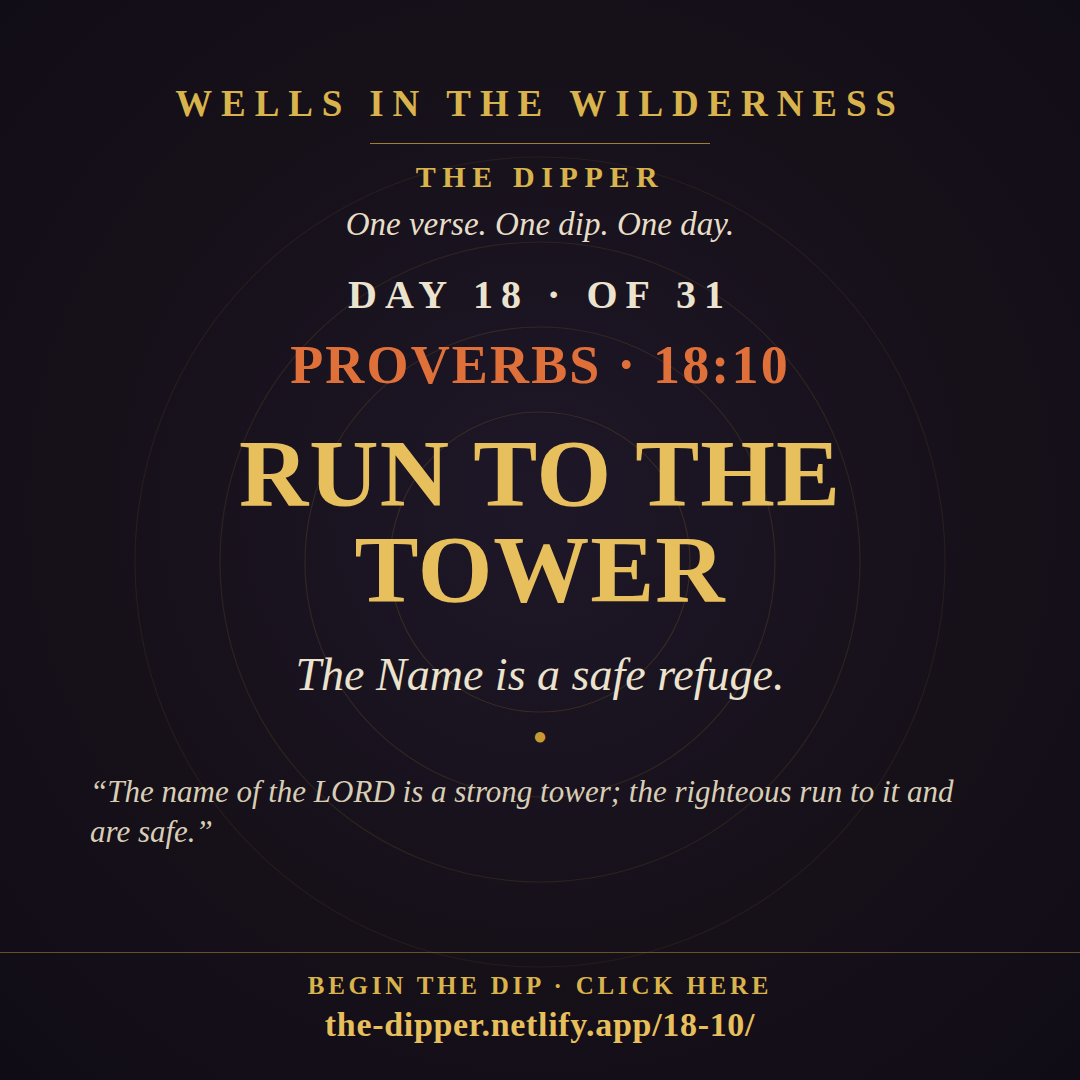
Run to
the Tower
the righteous man runs into it and is safe.”
Every walled city in Solomon's world had one: the migdal, the great tower — tallest, thickest, last. When the outer walls were breached, the tower was where you ran, and its gates stood open in exactly one direction: inward, for the fleeing. This verse hangs the LORD's own name on that architecture — and then puts the whole theology of faith into a single sprinting verb.
The Springs
What the verse says: the character of God — everything His name means — is a fortress. And faith, in the day of trouble, is not a feeling or a theory. It is a run: legs moving, dignity abandoned, straight for the gates.
Notice what the verse asks of the righteous: not to build the tower, defend it, or prove worthy of it — only to run into it. The tower does all the protecting. The runner's single contribution is the direction he flees.
The Wells
In Hebrew thought, a name is not a label but a character — the whole revealed nature of a person. The shem YHWH is everything God has shown Himself to be: Provider, Healer, Shepherd, Peace — the names stack through Scripture like courses of stone. The verse's claim is that God's track record is itself a structure you can get inside of.
The city's final citadel — tallest point, thickest walls, the place of last resort that had to hold when nothing else did. Oz adds might to the picture: not merely a tall building but strength itself in built form. Archaeology has uncovered these towers across Israel; their psychology survives in the verse — everyone in an ancient city knew exactly where they would run.
A flat sprint — the verb of messengers and of men fleeing for their lives. This is the verse's theology of faith in one word: not a posture of calm assent but motion toward, urgent and undignified. Nobody strolls to a tower during a siege. Prayer in crisis is meant to look like this word — immediate, fast, and headed somewhere specific.
Literally ‘set high’ — lifted beyond reach. The runner who enters the tower does not merely hide; he is elevated, placed above the battle where the enemy's arm cannot follow. It is the difference between ducking behind something and being raised over everything. That altitude — not the runner's speed — is what the verse calls safety.
and faith is a sprint through its gates.
The Aquifer
What running looks like without a siege
Strip the metaphor and the practice is concrete: running to the name means going, fast and first, to who God has revealed Himself to be — usually out loud. The old saints prayed the names: You are Provider — this bill is Yours. You are Peace — this 3 a.m. dread is Yours. You are Shepherd — I have lost the path. Each name is a gate in the tower wall. The run is naming the situation and naming the Name over it, before you have consulted anything else.
First resort, not last
Here is where most of us fail the verse: we treat the tower as the place you end up after everything else — after the worrying, the scheming, the calls, the spiral. The city under siege had it right: you run at the first breach, because distance from the tower is danger. Watch yourself this week: when trouble hits, where do you sprint first — the phone, the fridge, the spreadsheet, the spiral — and how far into the crisis does God get consulted?
Safety is altitude, not absence
Nisgav corrects a common disappointment with God: the tower does not make the army outside disappear. The siege may continue — the diagnosis, the lawsuit, the season. What changes is elevation: inside the name, you look at the same trouble from above it rather than beneath it. Psalm 61 prays this exactly: ‘lead me to the rock that is higher than I.’ The promise is not an emptied battlefield. It is a higher floor.
The tower's gates in the New Testament
Scripture eventually gives the tower its fullest name: ‘there is no other name under heaven given among men by which we must be saved’ (Acts 4:12), and ‘everyone who calls on the name of the Lord will be saved’ (Romans 10:13). The architecture holds from Proverbs to Pentecost: a name, a run, a rescue. The righteous of this verse are not the flawless — they are simply the ones who know which direction to flee.
Draw From the Well
Answer honestly. Write your answers down — ink slows the heart enough to hear.
Map your reflex honestly: when trouble hits, what do you actually sprint to first — and how many steps into the crisis does God typically get consulted?
Which of God's revealed names is the gate your current situation needs — Provider, Peace, Shepherd, Healer? What would it sound like to run there out loud, today, before anything else?
Safety is altitude, not absence: the siege may continue. Where have you been waiting for God to empty the battlefield, when the offer on the table is a higher floor above it?
Nobody strolls during a siege — but many of us walk to the tower slowly, ashamed of needing it again. What keeps your run undignified and immediate from becoming delayed and self-conscious?
The righteous runner's one contribution is direction. Is there someone in your life under siege right now who has forgotten where the tower is — and could you run there with them this week?
This Week’s Practice
- MORNINGRun first: at today's first sign of trouble — large or small — pray before you problem-solve, even if only one sentence.
- MID-DAYPray a name: choose the name of God your situation needs and speak it over the situation, out loud, at mid-day.
- EVENINGCheck your altitude: tonight, look at today's siege from inside the tower — same facts, higher floor — and write down what looks different.
Sources
- Hebrew text (Westminster Leningrad Codex): sefaria.org/Proverbs.18.10
- Lexicon — shem (H8034): blueletterbible.org/lexicon/h8034
- Lexicon — migdal (H4026): blueletterbible.org/lexicon/h4026
- Lexicon — ruts (H7323): blueletterbible.org/lexicon/h7323
- Lexicon — sagab (H7682): blueletterbible.org/lexicon/h7682