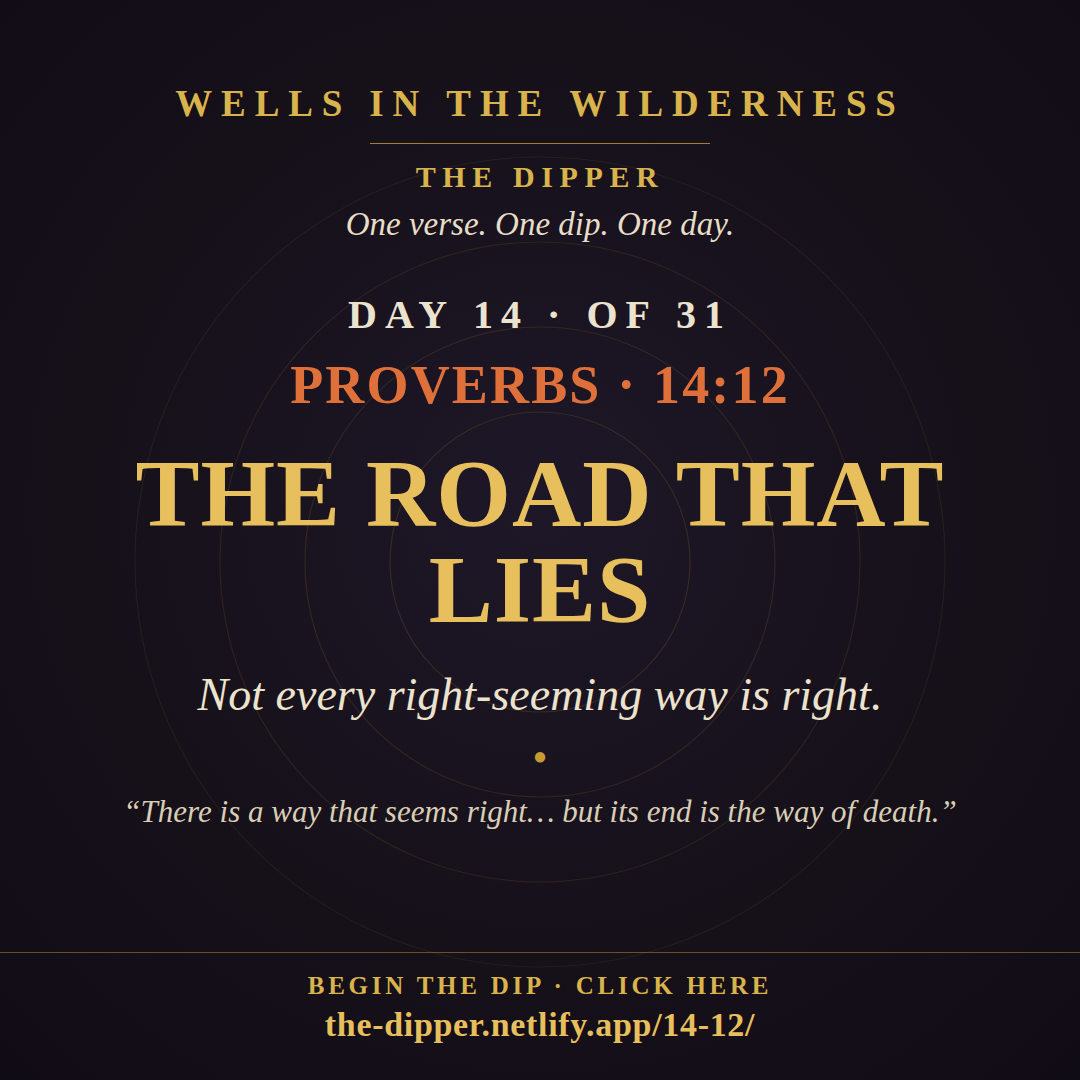
The Road
That Lies
but its end is the way to death.”
If you took the first dip at this well, two words in today's Hebrew should ring like a bell: derek and yashar — the road and the straightness of Dipper 3:6, back again with the lights off. There, God actively straightens the road of the one who knows Him. Here is the counterfeit: a road that merely seems straight. Same vocabulary, opposite destination — Solomon wrote the two verses to be held side by side.
The Springs
What the verse says: a road can look perfectly right from where you're standing — level, sensible, well-trodden — and still be walking you somewhere fatal. The view from the trailhead is not evidence.
Notice the quiet horror in the first word: yesh — “there is,” “it exists.” Solomon states it like a surveyor filing a report. Such roads are real, mapped, and busy. The verse is not a hypothetical warning; it is a fact about the terrain.
The Wells
The road-of-life word from Dipper 3:6 — habits, decisions, direction, the whole worn path of a person's living. Proverbs' geography has only roads and travelers; nobody stands still. Which makes the verse urgent rather than academic: you are on a derek right now, this season, and it is going somewhere whether or not you have checked.
The same root God performs in 3:6 — He will make straight your paths — now appearing as a mere appearance: a road straight “before a man,” in his own eyes. The wordplay is the theology: there is straightness God makes, and straightness a man sees, and the entire verse turns on learning to tell them apart.
The afterward — the far end, the final state, where a thing arrives when it is done arriving. Proverbs is obsessed with this word because wisdom's defining skill is acharit-sight: judging everything by its end rather than its opening mile. Fools evaluate roads by the view; the wise evaluate roads by the destination.
Solomon does not soften the terminus. In Proverbs, mavet is more than a heartbeat stopping — it is the whole gravity of ruin: the dead marriage, the dead conscience, the dead end, and finally death itself. Note the plural: “the ways of death” — the seemingly-right road does not end at a wall; it feathers out into a delta of destructions.
the test of a road is its end, not its view.
The Aquifer
Sincerity is not a compass
The most sobering word in the verse is “seems.” The traveler on this road is not a rebel sneering at the map — he is sincere. It genuinely looks right to him. Which dismantles the modern creed that authenticity is self-validating: you can be honestly, earnestly, wholeheartedly wrong, and the road does not grade on sincerity. Good intentions have walked every mile of the ways of death.
Why right-seeming roads deceive
Counterfeit roads work because they borrow real virtues for their first miles: the affair begins as friendship and feeling understood; the financial shortcut begins as providing for family; the drift from God begins as a busy season, reasonably explained. The opening stretch is always the best pavement on the road. That is not an accident of these roads — it is their design.
How to survey a road
Since the view lies, the wise traveler tests roads by other instruments. Three are reliable: the map — does God's word actually endorse this road, or have I only assumed it does? The end — acharit-check: where does this arrive in ten years, and who is already there? Look at the veterans of any road; they are its true advertisement. And other surveyors — wise counsel, because the one thing a self-deceived traveler cannot see is himself (Proverbs 12:15: the way of a fool is right in his own eyes, but a wise man listens).
Hold this verse with 3:6
Solomon gave us the pair on purpose. There is straightness a man perceives — and it kills; there is straightness God performs — and it arrives. The difference between the two roads is not the view, the pavement, or the traffic. It is the Companion. “In all your ways know Him, and He will make straight your paths” is not a devotional nicety; after today's verse it reads as survival instruction. Do not trust roads that merely seem yashar. Walk with the One who makes them so.
Draw From the Well
Answer honestly. Write your answers down — ink slows the heart enough to hear.
Where in your life right now are you navigating by “it seems right to me” — a decision, relationship, or direction whose chief evidence is the view from where you stand?
Counterfeit roads open with their best pavement. Looking back, when did a road's excellent first miles fool you — and what, in hindsight, were the early markers you explained away?
Run the acharit-check on your current biggest road: where does it arrive in ten years if nothing changes — and who do you know that is already standing at that destination?
Proverbs 12:15 says the wise man listens. Who has permission to survey your roads — to tell you a path you love looks wrong? If no one does, what does that itself tell you?
Set today's verse beside 3:6. On the road in question, are you asking God to bless a straightness you already chose — or walking with Him and letting Him do the straightening? What would switching actually require this week?
This Week’s Practice
- MORNINGCheck the map: this morning, take your biggest current decision and ask what Scripture actually says about it — read, don't assume.
- MID-DAYRun the end-check: at mid-day, follow one current habit ten years forward, honestly, and write the destination in one sentence.
- EVENINGCall a surveyor: before the week ends, ask one wise person to look at one road you love — and give them permission to say it's crooked.
Sources
- Hebrew text (Westminster Leningrad Codex): sefaria.org/Proverbs.14.12
- Lexicon — derek (H1870): blueletterbible.org/lexicon/h1870
- Lexicon — yashar (H3477): blueletterbible.org/lexicon/h3477
- Lexicon — acharit (H319): blueletterbible.org/lexicon/h319
- Lexicon — mavet (H4194): blueletterbible.org/lexicon/h4194