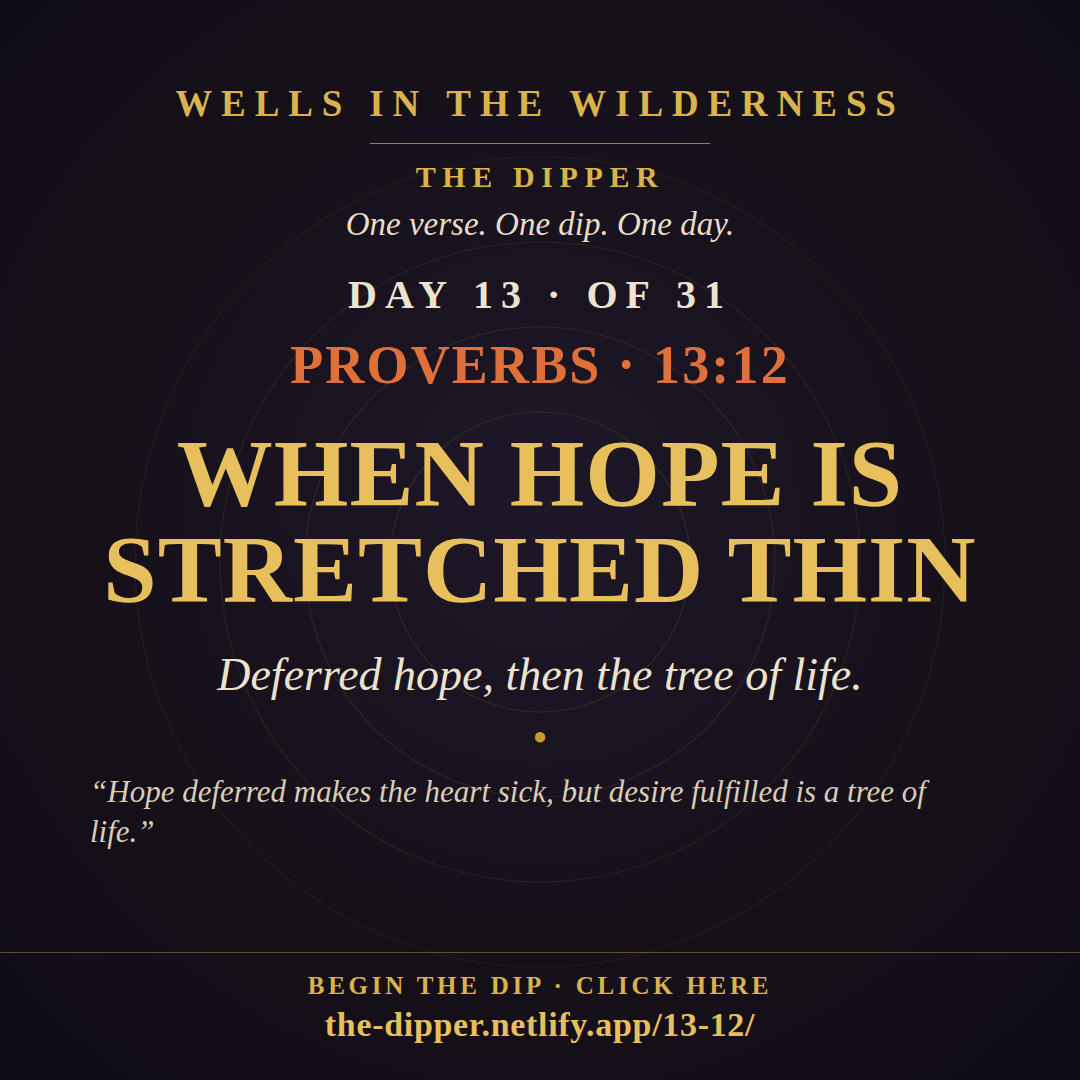
When Hope
Is Stretched Thin
but a desire fulfilled is a tree of life.”
This verse names an ache almost everyone at this well is carrying in some form: the prayer not yet answered, the prodigal not yet home, the healing, the child, the breakthrough that keeps not arriving. Solomon diagnoses the long wait with a doctor's honesty — and then plants a tree from Eden at the end of it.
The Springs
What the verse says: waiting a long time for something you deeply want genuinely sickens the heart — and the arrival of a true longing is nothing less than a taste of Eden.
Notice that the verse diagnoses before it comforts. It does not rush to the tree; it sits first with the sickness and calls it what it is. Scripture's comforts always work this way — they are strong precisely because they never begin by minimizing the wound.
The Wells
From yachal, to wait expectantly — this is not vague optimism but aimed hope: hope with an object, a face, a date it keeps watching for. That aim is what makes deferral hurt; you cannot be heartsick over something you never really wanted. The verse's pain is reserved for the ones who dared to hope specifically.
To draw, drag, stretch — the word for drawing a bow or dragging something long behind you. Hope m'mushshakhah is hope pulled taut like a rope under strain, month after month. Anyone in a long wait knows the sensation exactly: not the snap of a crisis but the ache of sustained tension that never gets to release.
A genuine illness word — the same vocabulary used for physical disease. Solomon refuses to spiritualize the cost of waiting: deferred hope produces real symptoms in a real heart. Three millennia later, medicine agrees that long uncertainty wears the body. Scripture said it first, and said it with compassion: the heartsick are actually sick, and deserve the gentleness the sick deserve.
Not a generic happy image — this is Eden's tree (Genesis 2:9), the one guarded by cherubim at the fall, the one that returns in the last chapter of the Bible (Revelation 22:2). When a long-awaited desire finally arrives, Solomon says, the taste is Edenic: for a moment the world works the way it was made to. Every fulfilled longing is a rumor of the garden — and of its restoration.
and plants Eden's tree at the end of it.
The Aquifer
Permission to call it what it is
The verse's first mercy is diagnostic honesty. If your hope has been stretched for years — the marriage, the diagnosis, the wandering child, the door that stays shut — Scripture does not tell you to feel fine. It certifies the sickness as real. That matters pastorally: the heartsick often add guilt on top of grief, as though strong faith should not ache. Solomon, under inspiration, says the ache is not a faith failure. It is what hearts do when hope is drawn taut.
Waiting in company
The Bible turns out to be a book largely about deferred hope: Abraham a quarter-century between promise and Isaac, Joseph forgotten in the prison, Hannah weeping at Shiloh year after year, Israel four hundred silent years before a cry in Bethlehem. The stretched rope is the normal terrain of faith, not its exception — and in every one of those stories, the deferral was doing formation work the fulfillment alone could not have done. What God grows in the waiting, He harvests at the arrival.
Keep the heart alive while it waits
Heartsickness untreated can curdle into something worse: the decision to stop hoping at all, which feels like relief and is actually a small death. The old paths keep waiting hearts alive — keep naming the hope out loud to God (the Psalms are largely this); keep it in community rather than carrying it alone; and keep planting small, near hopes alongside the great deferred one, because a heart needs some harvests while it waits for the harvest.
The tree at the end of the book
The verse's final word is quietly eschatological. Some longings will be fulfilled in this life, and each arrival will taste like Eden. Some will not — and for those, the tree of life reappears at Scripture's last page, leaves for the healing of the nations, every deferral ended. For the believer, no true hope is ever finally deferred; some are just waiting for the chapter where the tree stands by the river. That is not a consolation prize. It is the point of the story.
Draw From the Well
Answer honestly. Write your answers down — ink slows the heart enough to hear.
Name your stretched rope: what is the specific, aimed hope that has been drawn out longest in your life right now — and how long has the tension held?
Where has heartsickness added guilt on top of grief — the sense that stronger faith shouldn't ache like this? What does this verse's diagnosis give you permission to release?
Abraham, Joseph, Hannah — pick the waiting story that most resembles yours. What was the deferral demonstrably building in them that the quick answer could not have built?
What small, near hope could you plant alongside the great deferred one this month — a harvest the heart can actually reach while it waits?
Read Revelation 22:1–2 beside this verse. Which of your longings belongs to the category that will meet its tree in this life — and which are you ready to entrust to the last chapter?
This Week’s Practice
- MORNINGName it to God: this morning, pray the deferred hope out loud, specifically — the Psalms give full permission.
- MID-DAYTend a near hope: take one concrete step today on a small hope that can actually be harvested this season.
- EVENINGEnd at the tree: tonight, read Revelation 22:1–2 slowly, and put your longest wait in the shade of that tree before sleep.
Sources
- Hebrew text (Westminster Leningrad Codex): sefaria.org/Proverbs.13.12
- Lexicon — tochelet (H8431): blueletterbible.org/lexicon/h8431
- Lexicon — mashak (H4900): blueletterbible.org/lexicon/h4900
- Lexicon — machalah (H4245): blueletterbible.org/lexicon/h4245
- Lexicon — etz (H6086): blueletterbible.org/lexicon/h6086