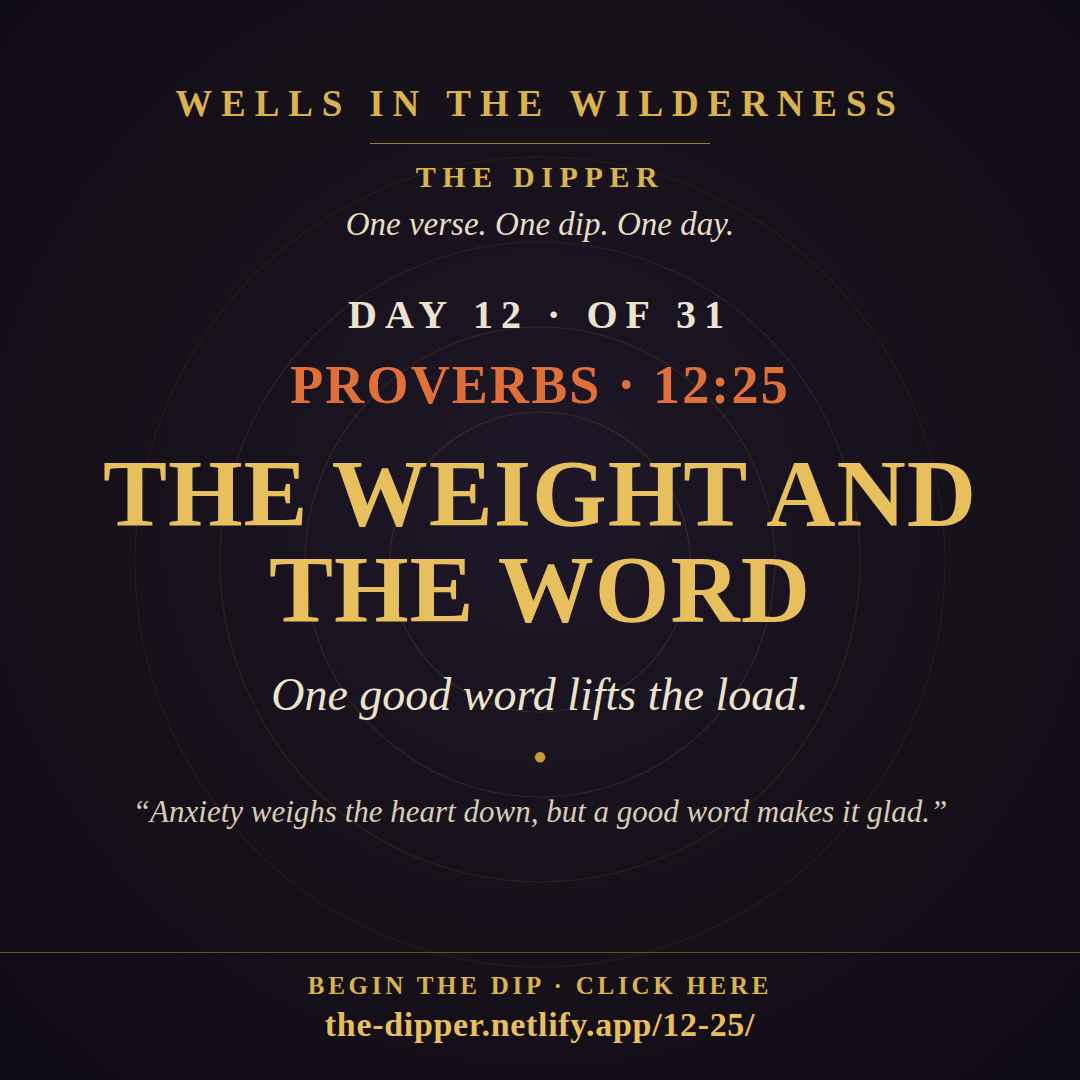
The Weight
and the Word
but a good word makes him glad.”
Three thousand years before anyone coined the term, Solomon described anxiety with a precision that still lands: a weight, carried inside the heart, that bends a person toward the ground. And then — this is the astonishing part — he prescribes something almost absurdly small. Not a program. A word.
The Springs
What the verse says: worry is not weightless. It sits in the heart like a physical load and bows a person down — and one good word, rightly placed, can lift what the load has bent.
Notice the mismatch in scale, because it is the verse's whole genius: the problem is described as a crushing weight; the remedy is described as a single word. Solomon is telling you something about the leverage of speech — a few grams of the right words can move what shoulders cannot.
The Wells
Anxious dread — fear stretched out over time, worry about what has not happened yet. Elsewhere the word describes trembling over coming judgment and rationed bread eaten “with anxiety” (Ezekiel 4:16). It is the fear that has moved in and set up housekeeping: not a fright that passes, but a tenant.
To bow, to be bent double — the posture word of Scripture, the same root used for bowing low before a king. Solomon's picture is physical and pitiless: anxiety puts the heart in the posture of a burdened man, folded toward the ground. Anyone who has carried a long dread knows the verse is not exaggerating; the bending is real, and it can be felt in the body.
The great Hebrew word for word — the same davar by which God created (“and God said”) and spoke to the prophets. Hebrew thought never treated words as mere air: a davar is a thing with mass and consequence, sent out to do work. Which is exactly why one of them, aimed well, can counter a weight.
Real gladness — the word used for festival joy, for rejoicing before the LORD. Note what the verse claims: the good word does not merely distract the anxious heart or manage it. It gladdens it — changes its actual condition, straightens what was bent. Small cause, disproportionate effect: that is grace's usual signature.
rightly timed, straightens it.
The Aquifer
Scripture takes the weight seriously
Notice what the verse does not do: it does not scold the anxious heart or call the weight imaginary. Scripture's realism here is itself a kindness — the burden is named as a burden. If you carry de'agah today, the first gift of this verse is validation: God's own word says yes, it is heavy, and yes, it bends people. You are not weak for being bent by a real weight. And weights this real are also worth bringing to people who help carry them — a wise friend, a pastor, a good doctor. Proverbs itself counsels many counselors.
The leverage of a good word
Why can something so small move something so heavy? Because anxiety is largely made of words already — the looping interior sentences of dread — and words are countered at their own level. A true sentence, spoken by someone who means it, gets into the same room where the anxious sentences live. “I'm with you.” “You are not behind.” “We will figure this out together.” Grams, moving tons.
You are someone's good word today
The verse quietly deputizes every reader. Somewhere in your circle today is a bent heart, and you may be carrying — unaware — the exact davar tov it needs: the check-in text, the specific encouragement, the “I've noticed how hard you're working.” The word costs you thirty seconds. Solomon says it can straighten a spine. Very few investments in the kingdom pay at that ratio.
Take the word yourself
And when the bent heart is your own: the same remedy applies, from the deepest source. God's promises are davar tov engineered for exactly this — “cast your anxieties on him, because he cares for you” (1 Peter 5:7); “fear not, for I am with you” (Isaiah 41:10). The practice is old and unfashionable and it works: put the good word in your mouth, out loud, and let it argue with the weight.
Draw From the Well
Answer honestly. Write your answers down — ink slows the heart enough to hear.
Where is de'agah currently bending you — the dread that has moved in as a tenant rather than a passing fright? Name it in writing; weights lose some mass when measured.
Think of a time one sentence from another person visibly lifted you. What made that word land — the content, the timing, or the person it came from?
Who in your circle is walking bent right now? What is the specific davar tov you are uniquely positioned to speak to them — and what has been stopping you?
Anxiety is made largely of interior sentences. Write down the two or three sentences your worry keeps repeating — then write the true sentence from Scripture that answers each one.
The verse's remedy is small but must be delivered. What is your plan for taking the good word daily — a promise memorized, spoken aloud, kept where the weight usually finds you?
This Week’s Practice
- MORNINGSend the word: before noon, deliver one specific, true, good word to one bent person — thirty seconds, disproportionate return.
- MID-DAYAnswer the loop: when the anxious sentence plays today, answer it out loud with the true one you wrote down.
- EVENINGWeigh in at night: name what felt lighter today and which word did the lifting — keep a record of the leverage.
Sources
- Hebrew text (Westminster Leningrad Codex): sefaria.org/Proverbs.12.25
- Lexicon — de'agah (H1674): blueletterbible.org/lexicon/h1674
- Lexicon — shachah (H7812): blueletterbible.org/lexicon/h7812
- Lexicon — davar (H1697): blueletterbible.org/lexicon/h1697
- Lexicon — samach (H8055): blueletterbible.org/lexicon/h8055