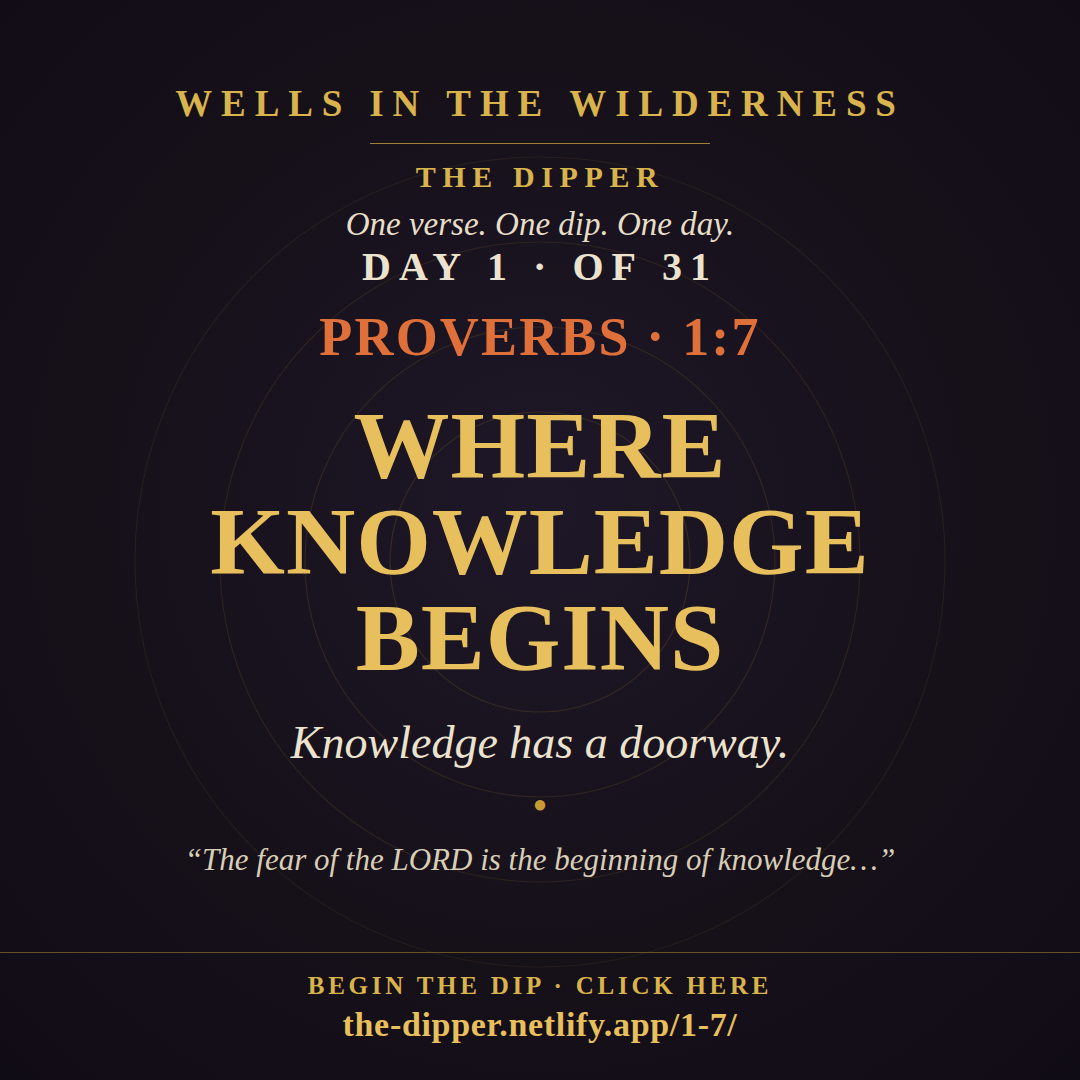
Where
Knowledge Begins
fools despise wisdom and instruction.”
This is the thesis of the entire book — the sentence every other proverb hangs from. Solomon places it at the front door like a sign over a school: before geometry, before ethics, before a single saying about money or marriage or the tongue, he tells you where knowledge begins. Four Hebrew words carry the claim.
The Springs
What the verse says: all real knowledge has a starting point, and it is not a book, a method, or an IQ — it is standing in right awe of the God who made everything knowledge is about.
Notice the verse has two halves and two postures. One posture bows — and learns. The other sneers — and stays a fool. Solomon is telling you the difference between the wise and the foolish is not brains. It is a bend in the knee.
The Wells
Not the fear that runs from God — the awe that runs to Him. Yirah is what Israel felt at Sinai and what Isaiah felt in the temple: the knee-weakening recognition that God is God and you are not. It is the fear that ends all other fears. Scripture's own picture: a child's reverence for a good father — close enough to climb into his lap, awed enough to never mock him.
The word that opens the Bible: b'reshit, “in the beginning” (Genesis 1:1). It means both first in order and chief in rank — the cornerstone and the capstone at once. Solomon's claim is enormous: knowledge has a Genesis. Skip the fear of the LORD and you can still gather facts, but you have a library with no foundation under it.
From the verb yada — the same intimate, experiential knowing at the heart of Dipper 3:6. Da'at is not trivia; it is knowledge you live in, the way a rancher knows his land or a sailor knows the sea. Which is why it must begin with awe: you cannot rightly know the creation while shrugging at the Creator.
In Proverbs, a fool is never someone with a low IQ — the word is moral, not mental. The evil is the person who bazah — despises, holds in contempt — what could make him wise. Folly in this book is not a lack of information. It is a chosen posture toward correction: the curled lip. Which means, hopefully, that no one is stuck being a fool.
it is the doorway.
The Aquifer
The fear that ends all other fears
Modern ears hear “fear” and think terror — but terror makes you hide from someone, and Proverbs spends thirty-one chapters inviting you closer. Yirah is the awe that rearranges your loves: when God is the biggest thing in the room, nothing else in the room can bully you. People who fear the LORD rightly end up the least fearful people you know.
A Genesis for knowing
Reshit says knowledge has a starting line, and everyone is standing somewhere with respect to it. This is not anti-intellectualism — Solomon catalogued trees, animals, and proverbs by the thousands (1 Kings 4:32–33). It is the claim that facts without reverence eventually bend toward arrogance, and reverence turns every field of study into a tour of Someone's workshop.
The fool is a posture, not a diagnosis
The most hopeful word in the verse is hiding in its harshest line. Because the fool is defined by what he despises — a chosen contempt — folly is not a life sentence. The moment contempt turns to teachability, the fool has stopped being one. Every Dipper in this series is a small act of un-foolishness: showing up to be instructed.
Day one of thirty-one
This verse is why the series exists. Thirty-one chapters from now, the book will close the way it opened — “a woman who fears the LORD is to be praised” (31:30). Everything in between is what life looks like once you've walked through the doorway. Welcome to the well.
Draw From the Well
Answer honestly. Write your answers down — ink slows the heart enough to hear.
In your own words, what is the difference between being terrified of God and standing in yirah — reverent awe — of Him? Which one describes your current posture?
If the fear of the LORD is the reshit — the foundation — of knowledge, what have you been trying to build without it? Where is the structure showing cracks?
Proverbs defines the fool morally, not mentally: someone who despises correction. When was the last time you received correction well — and when did you curl a lip at it?
Solomon studied trees, animals, and human behavior relentlessly (1 Kings 4:32–33) — reverence made him more curious, not less. What is one field of your life where awe of God would change how you learn?
This is day one of thirty-one chapters. What do you want to be true of you by chapter 31 that is not true today — and what will you ask God for at the start of this walk?
This Week’s Practice
- MORNINGBegin the day by naming one thing about God that is simply too big — and let the size of it settle before you pick up your phone.
- MID-DAYCatch yourself once in the act of “knowing” something — a skill, a fact, your work — and trace it back to the One who made it knowable.
- EVENINGBefore sleep, ask: did I despise any correction today? If so, name it, and un-despise it.
Sources
- Hebrew text (Westminster Leningrad Codex): sefaria.org/Proverbs.1.7
- Lexicon — yirah (H3374): blueletterbible.org/lexicon/h3374
- Lexicon — reshit (H7225): blueletterbible.org/lexicon/h7225
- Lexicon — da'at (H1847): blueletterbible.org/lexicon/h1847
- Lexicon — evil (H191): blueletterbible.org/lexicon/h191